Innovation Solopreneurship
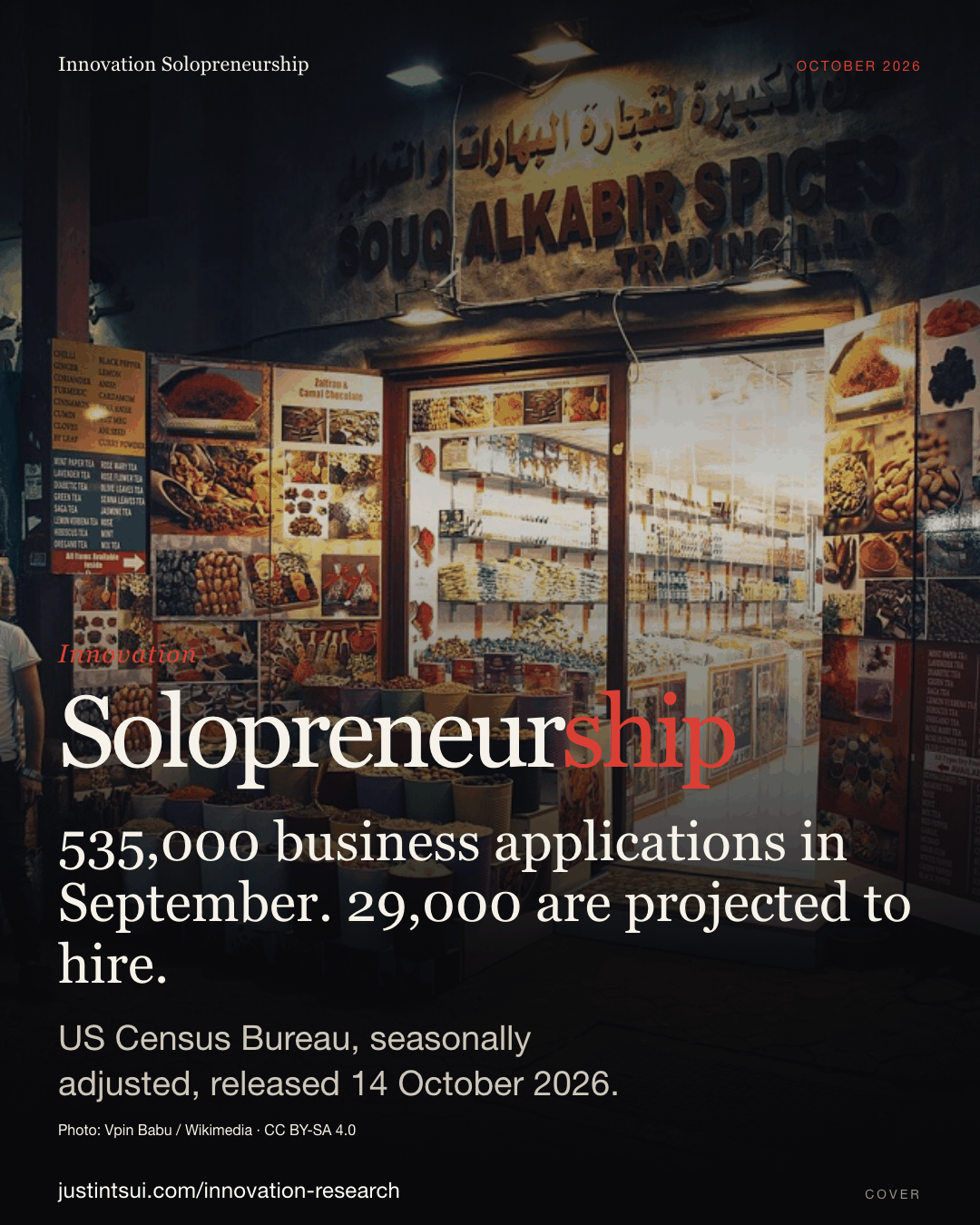
Solo businesses are multiplying in most regions this year. Developed Europe is the exception. 534,947 US applications in September, 84.2m Chinese individual businesses past their third year, 180,321 Brazilian MEIs deregistered in August. In Europe the two largest markets disagree: France added 204,000 auto-entrepreneur accounts while Germany’s solo share kept falling.

The month in one idea
Applications outpace the businesses that hire.
The Census Bureau counted 534,947 business applications in September 2026 and projects 29,022 employer formations from that cohort, 5.4% of it. The nine-month total to September is 4.73m applications.
Two things changed at once. Generative AI cut the cost of building alone: industries with the highest task-level exposure formed 20% more startups after ChatGPT, and on Product Hunt the entry came disproportionately from solo founders (Bena, Bian and Giannetti, CEPR, Sep 2026; Kim, Kang and Song, arXiv, May 2026). The salaried alternative thinned over the same period. UK hiring ran 14% below the year before in April 2026, and 30 of 38 tracked entry-level occupations were shrinking, led by accountancy, design and software engineering (DSIT and LinkedIn, Jun 2026). Whether one caused the other is not settled. The US survey that measures AI use covers employer firms only and finds adoption below 20% among the smallest, while most one-person businesses never appear in it. Europe is the exception, and it is not one story. Germany has more AI in its smallest firms and a shrinking stock of them; France’s register grows while half of it declares no revenue. The Europe page takes the two apart.
- 534,947 US business applications, September 2026
- 29,022 projected employer formations, 5.4% of the cohort
- 4.73m applications in the nine months to September 2026
29,022 projected employer formations
5.4% of September applications
Source: U.S. Census Bureau, Business Formation Statistics, 14 Oct 2026 · tier noted on the issue page.
Links: Bena, Bian & Giannetti (CEPR) · Kim, Kang & Song (arXiv) · Census BTOS
Analysis
AI adoption is a size story before it is a country story.
Twenty per cent of EU enterprises with ten or more employees used AI in 2025, up from 13.5% a year earlier (Eurostat, isoc_eb_ai, 11 Dec 2025). The average hides the pattern that matters. Small firms: 17.0%. Medium: 30.4%. Large: 55.0%. The same gradient runs through the American survey, where 37% of firms with 250 or more employees report AI use against fewer than 20% of those with four or fewer (Census BTOS, May 2026). Firm size explains more of the variation than country does. Country differences are real but second order: Denmark reaches 42.0%, Romania 5.2%, and Germany (26.0%) sits eight points above France (18.2%). The gap survives the change of measure. Eurostat puts German small enterprises at 23.1% and French at 15.0%, 8.1 points apart; the two national surveys of solo and micro operators put them at 51.2% and 40%, 11.2 points apart (ifo/Jimdo, Jun 2026; France Num, Sep 2026). Different instruments, same order. What the ordering does not do is explain business formation. Germany has more AI in its smallest firms on every measure here and a falling stock of solo businesses; France has less and a growing register. That is the contradiction the regional pages work through.
20.0% EU enterprises using AI, 2025
8.1 pts German lead over France, small firms
Source: Eurostat isoc_eb_ai, 11 Dec 2025 · U.S. Census BTOS, May 2026 · ifo/Jimdo, 16 Jun 2026 · France Num, Sep 2026 · tier noted on the issue page.
Links: Eurostat · Census BTOS · ifo Institut · France Num 2026

Case study

It made $100 a month for 700 days, then $8,429.
Piotr Obidowski built Visualizee while working full time and held near $100 a month for two years before a conversational interface and a switch to subscriptions took it to $8,429 MRR, Stripe-verified.
$100 monthly revenue for two years
$8,429 MRR, Stripe-verified
292 active subscriptions
Source: TrustMRR, Stripe-verified · Starter Story interview (tier D) · tier noted on the issue page.
Case study
Six months, one founder, $80M.
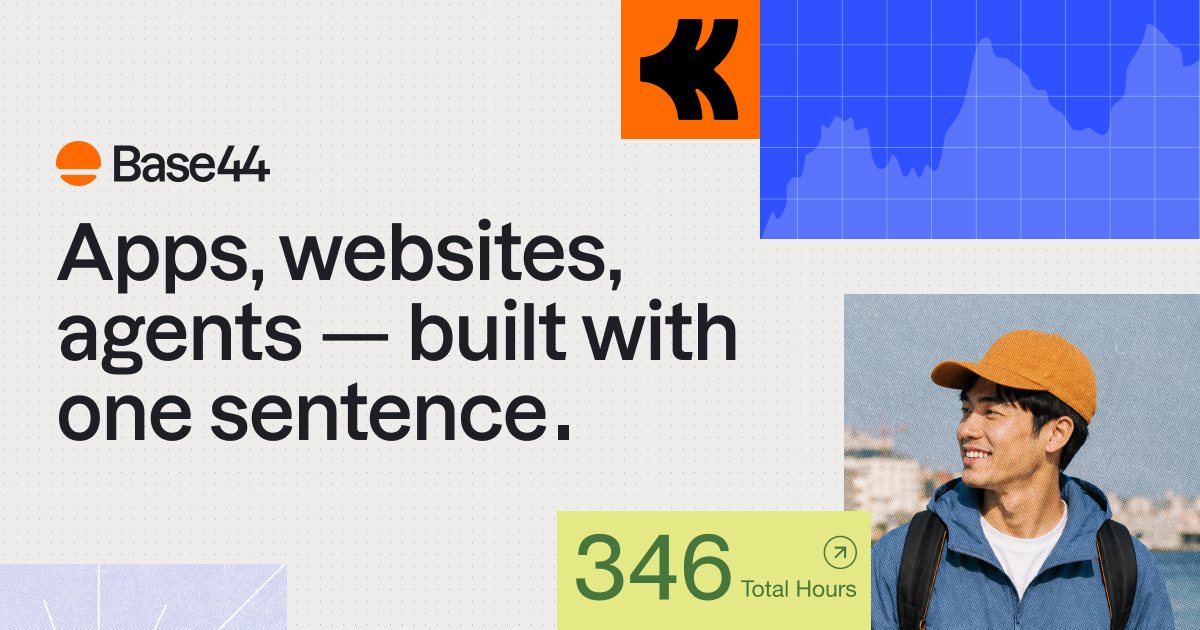
Maor Shlomo built Base44 in public, kept it profitable after token costs, and sold it to Wix six months after launch for $80M at $3.5M ARR. Publishing the profit figure made the growth claim checkable.
$80M all-cash sale to Wix
$3.5M ARR at acquisition
$189K profit in May 2025
Source: TechCrunch (tier C) · tier noted on the issue page.

North America
One in five new applications is retail.
Retail trade filed 110,048 business applications in September 2026, 20.6% of the 534,947 total, ahead of professional services at 78,937 and construction at 48,078.
110,048 retail applications, Sep 2026
20.6% of all applications
Source: U.S. Census Bureau, Business Formation Statistics, 14 Oct 2026 · tier noted on the issue page.
South America
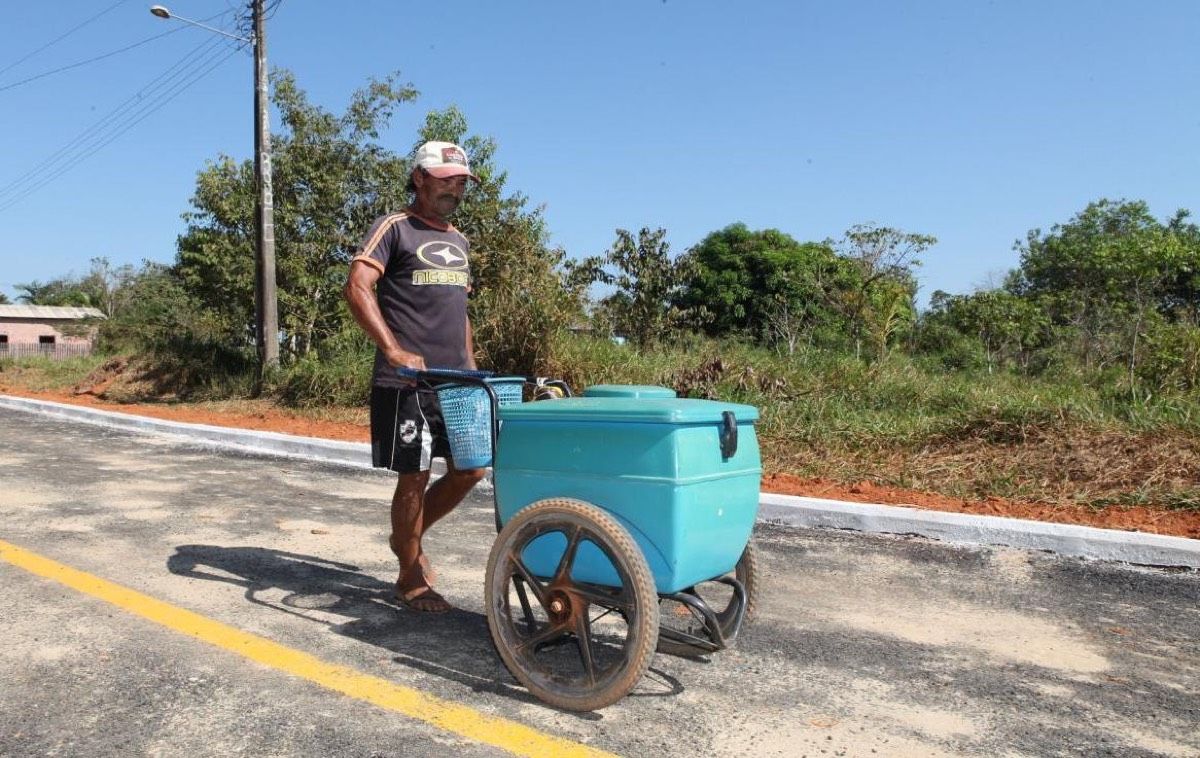
Formalised, then deregistered.
Brazil deregistered 180,321 MEIs in August 2026, leaving 13.66M active on $698 a month. A law in force since 21 October lifts the annual ceiling 36% from January and forgives federal debts booked to 13 October.
13.66m active MEIs, Aug 2026
+36% ceiling, Jan 2027
Source: Receita Federal via Censo Empresarial · Sebrae · LC 238/2026 (Câmara, Senado) · tier noted on the issue page.
Asia
Two registers, two different objects.
China counts 84.2M individual businesses more than three years old, 65.8% of the register (SAMR, March 2026). India counts 77.6M Udyam micro registrations.
84.2m China, 3+ years old
77.6m Udyam micro, Feb 2026
Source: SAMR, 26 Mar 2026 · Ministry of MSME, Feb 2026 · tier noted on the issue page.
Europe

Germany loses one-person firms. France keeps registering them.
Germany has AI in half its solo and micro firms and a shrinking stock of them. France’s register grows while half of it declares no revenue.
Germany: 51.2% of solo and micro firms used AI in 2026, while solo self-employment holds 3.5% of employment and is still falling. The 55-64 cohort runs 5.2% against 1.1% at 15-24, so the stock ages faster than it renews (ifo/Jimdo, 16 Jun 2026; Destatis, 23 Jul 2026). France: 3.186m auto-entrepreneur accounts at end-June 2025, up 204,000 in a year, on 758,000 registrations against 554,000 deregistrations, with 40% of TPE-PME reporting at least one AI tool in 2026 (Urssaf Stat’UR 413, 29 Jan 2026; France Num, Sep 2026). The French figure comes from an administrative register, so it counts accounts. Only 49.8% declared any revenue, and the average declarant billed 5,072 euros a quarter. The two series measure different things, and the difference matters more than the direction. What the pair does show is that AI adoption does not track solo formation: the country with more AI in its smallest firms is not the country adding them.
51.2% German solo/micro AI use
3.19m French auto-entrepreneur accounts
Source: ifo/Jimdo, 16 Jun 2026 · Destatis, 23 Jul 2026 · Urssaf Stat’UR 413, 29 Jan 2026 · France Num, Sep 2026 · tier noted on the issue page.
Links: ifo Institut · Destatis · Urssaf Stat’UR 413 · France Num 2026
Innovation Solopreneurship measures the one-person economy every month. Every number links to its registry or survey. justintsui.com/innovation-research
About this research
This issue is compiled from publicly available sources: official statistics, company filings, industry
associations, peer-reviewed papers, app-store and marketplace data, and named press reporting, together with
published figures from subscription databases such as valuation registers and app-revenue panels. Those figures are
attributed as published and never re-estimated. Every figure carries its publisher, date, basis and link.
Principal sources for Solopreneurship: Census Bureau (NES) · Eurostat · IRS SOI · SAMR · TrustMRR · the interviews cited in each story.
This is an editorial digest for general information. It is not investment, legal or
purchasing advice. Corrections are published against the issue and the underlying evidence table is updated.