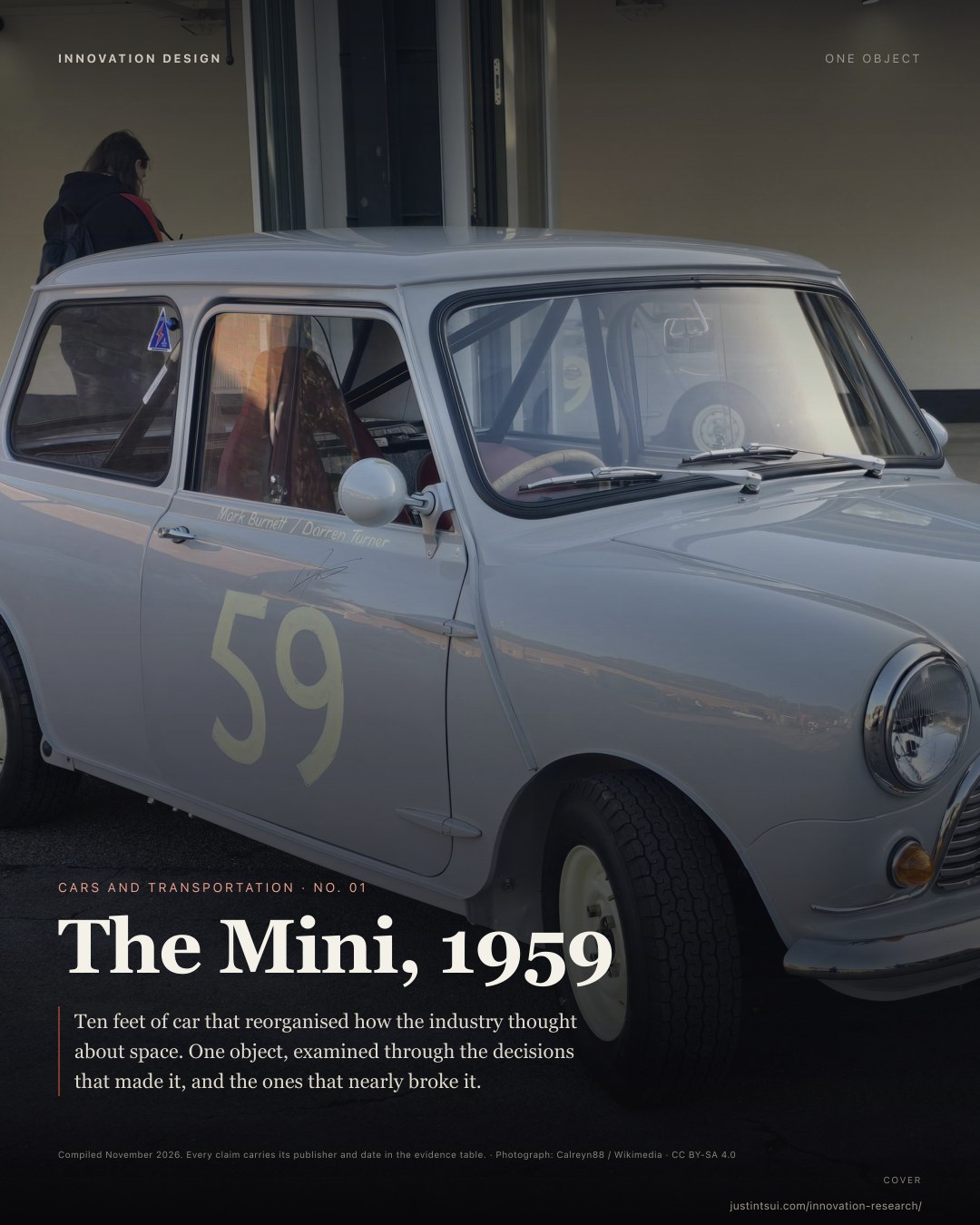
Ten feet of car that reorganised how the industry thought about space. One object, examined through the decisions that made it, and the ones that nearly broke it.

The brief
A car designed by a fuel crisis.
In July 1956 Egypt nationalised the Suez Canal, and by December Britain was rationing petrol. Sales of cars with engines of 900cc to 1,000cc quadrupled between 1956 and 1957, and the small German imports with three wheels and moped engines were becoming a common sight. Leonard Lord, the head of the British Motor Corporation, is said to have told his designers that he wanted those cars off the road, and he wanted them replaced by something British.
The man he asked was Alec Issigonis, who had left BMC for Alvis in 1952 and come back after that venture failed. The project was given the code ADO15 and a team that was, by the standards of any car company then or now, absurdly small: Issigonis, two close colleagues, four draftsmen and a pair of student engineers. There was no budget for a new engine, so the car would use the existing A-series.
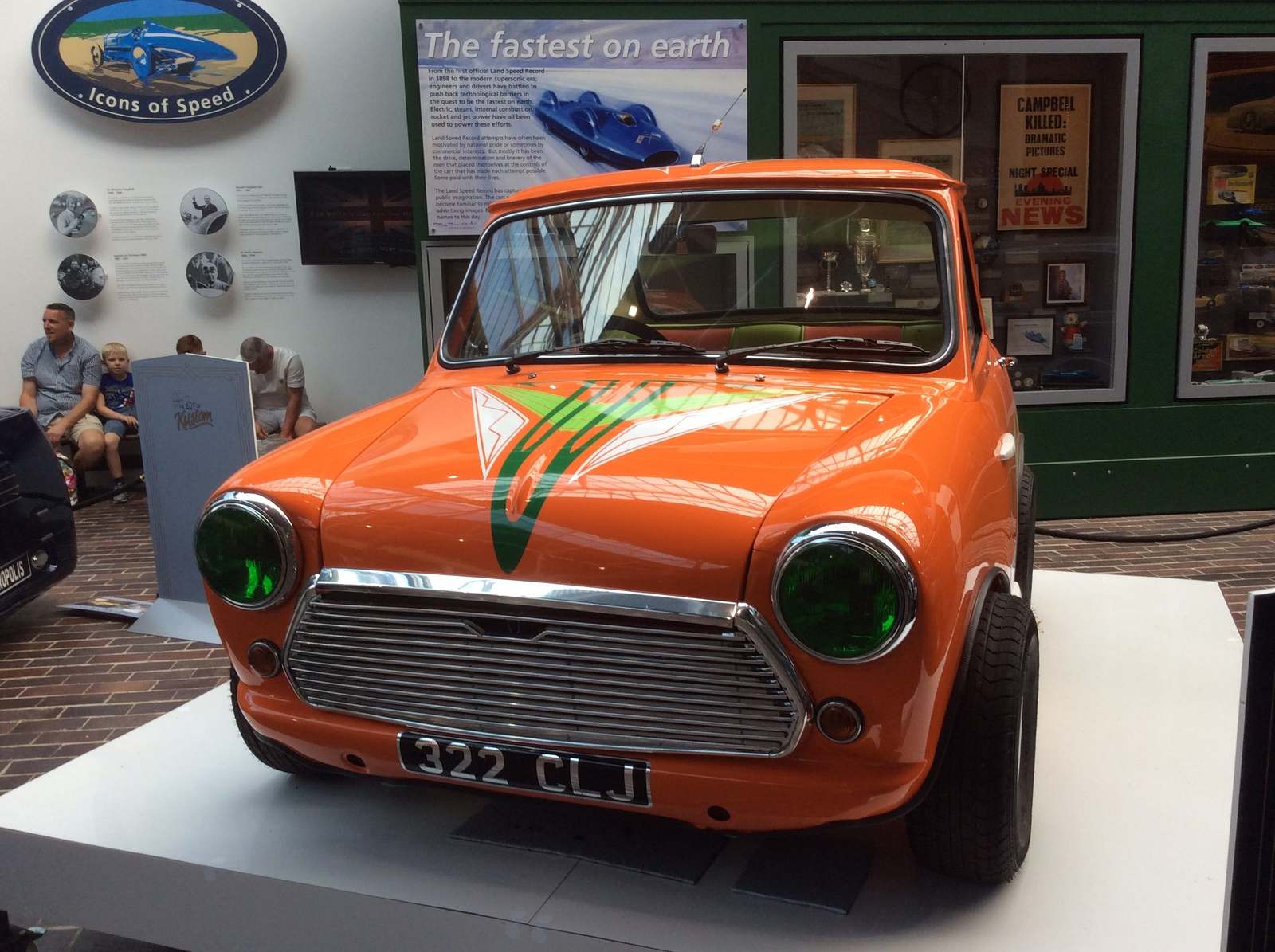
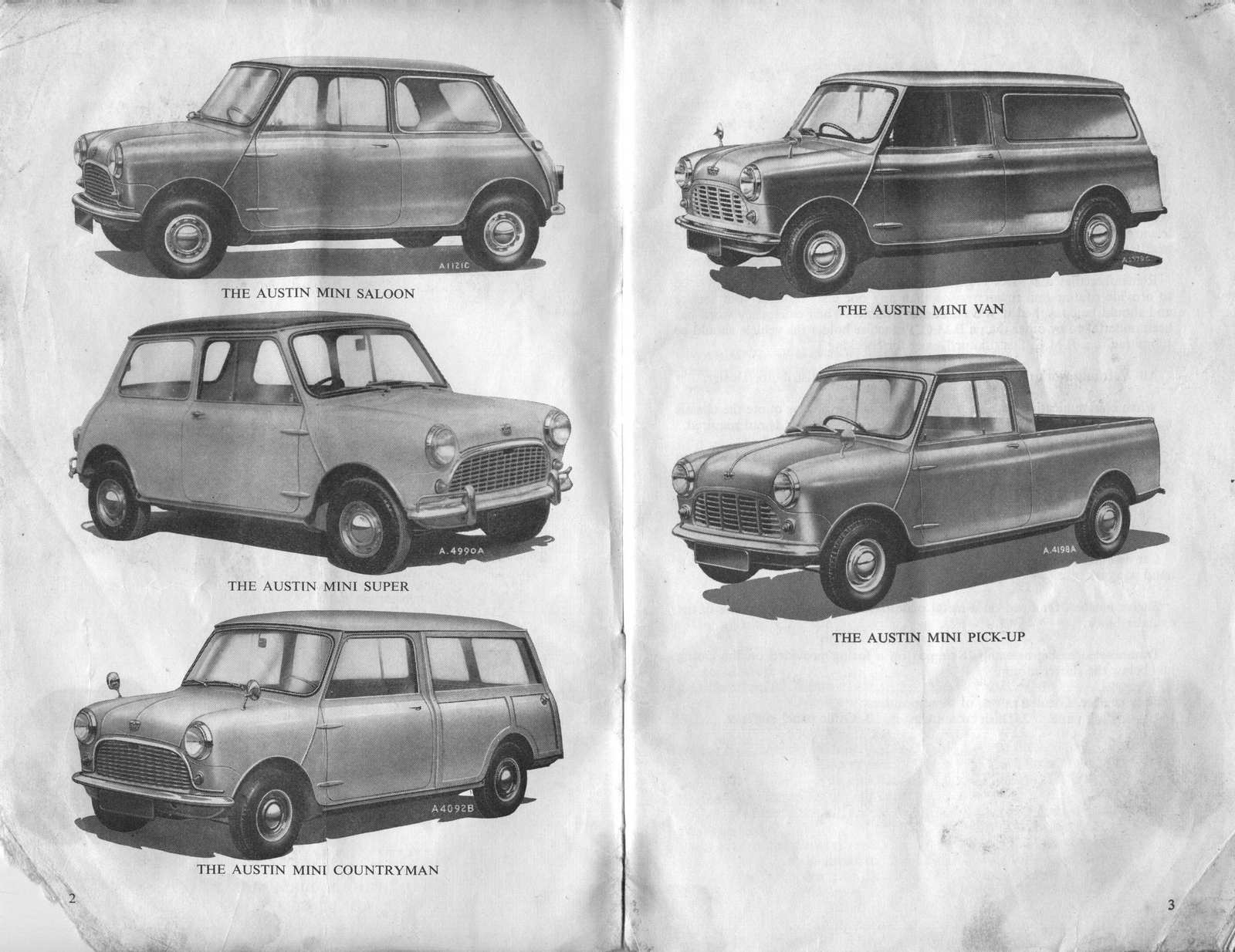
The target was ten feet long, and room for four adults and their luggage. That single number decided everything that followed: the engine would sit sideways, the gearbox would go underneath it in the sump, the wheels would shrink to ten inches, and the suspension would use rubber cones instead of springs. The Mini launched in August 1959 as the Austin Se7en and the Morris Mini-Minor, at £496 19s 2d.
The brief was a length. The design was everything that length made impossible any other way.
Sources: AROnline, Mini ADO15 development story · The Independent, 28 Aug 1994
FEES · functional
It did more with ten feet than anything before it.
Functional is measured against the job, and the job was four people, their bags, and a small engine. Ten feet of car, 3,054 mm bumper to bumper, with the wheels at the four corners and the overhangs all but deleted. The wheels sat at the four corners, the overhangs were all but deleted, and the cabin became a box rather than a tapered cone.
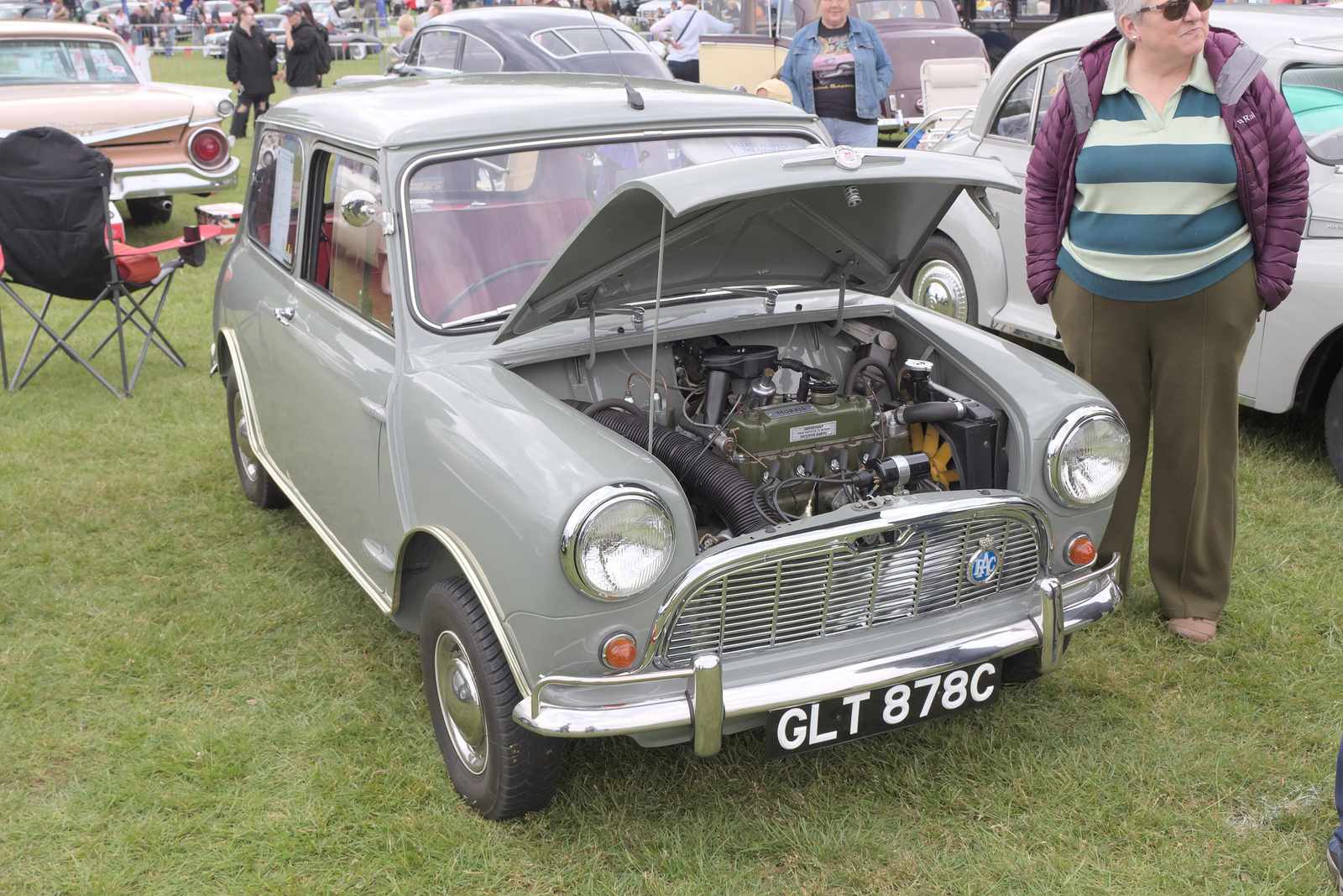
Getting there needed three linked decisions. Turning the engine sideways shortened the bonnet by more than a foot. Putting the gearbox in the sump under the crankshaft removed the transmission tunnel and the prop shaft. Ten-inch wheels let the floor sit low without the arches intruding. Change any one of the three and the others stop working.
The result was a car that carried four adults at 40 miles to the gallon, parked in spaces nothing else could use, and cost less than any comparable car in Britain. The functional case is not that it was fast or luxurious. It is that it made a new unit of space available at a price people could pay.
The packaging also explains the car’s limitations. A ten-foot shell with four adults inside has no crush space, which is why the Mini’s safety record in a serious collision was poor even by the standards of its own decade. The same economy of space that made it remarkable made it vulnerable, and no amount of later reinforcement changed the geometry.
Functional design is usually discussed as a list of features. The Mini is a better case because its function is a single number, and every other property of the car, good and bad, is a consequence of that number.
What the Mini replaced matters to the functional score. The bubble cars it was built to displace carried two people, usually at 50 mph, with the engine behind the seats and no meaningful luggage space. Against that benchmark the Mini was not a small improvement; it was a different category of object at a similar price.
Packaging is not a styling exercise. It is the arithmetic of what a customer gets for a given footprint.
Sources: BMW Group, Mini heritage material · Wikipedia, Mini
FEES · experiential
It feels quicker than it is, and that is engineering.
The Mini’s steering is unassisted and quick, the wheelbase is short, and the centre of gravity sits close to the road. The consequence is a car that feels alive at 30 mph, which is where most of its life was spent. Owners describe the sensation as go-kart-like, and the phrase is accurate rather than nostalgic: the geometry genuinely does most of the work.
The cost of that experience is paid in comfort. Rubber-cone suspension is firm, the cabin is loud at motorway speed, and the ride transmits surface texture the way a small boat transmits waves. Passengers notice. Drivers forgive it, which is the trade the car was designed to make.
What the car does unusually well is give feedback without demanding skill. The limits are low and legible, so an ordinary driver can approach them safely. That is a deliberate design position: a slow car that feels fast is more satisfying on a public road than a fast car that feels slow.
There is a second, quieter experience the car delivers: visibility. Thin pillars, a low waistline and upright glass give the driver a view most modern cars have traded away for crash structure and aerodynamics. In traffic, that changes how much of the road a driver can read without moving their head.
A car can be honest about its limits and still be fun. Most are dishonest in one direction or the other.
Sources: AROnline, Mini development story · Wikipedia, Mini
FEES · emotional and social
The car became a costume people put on.
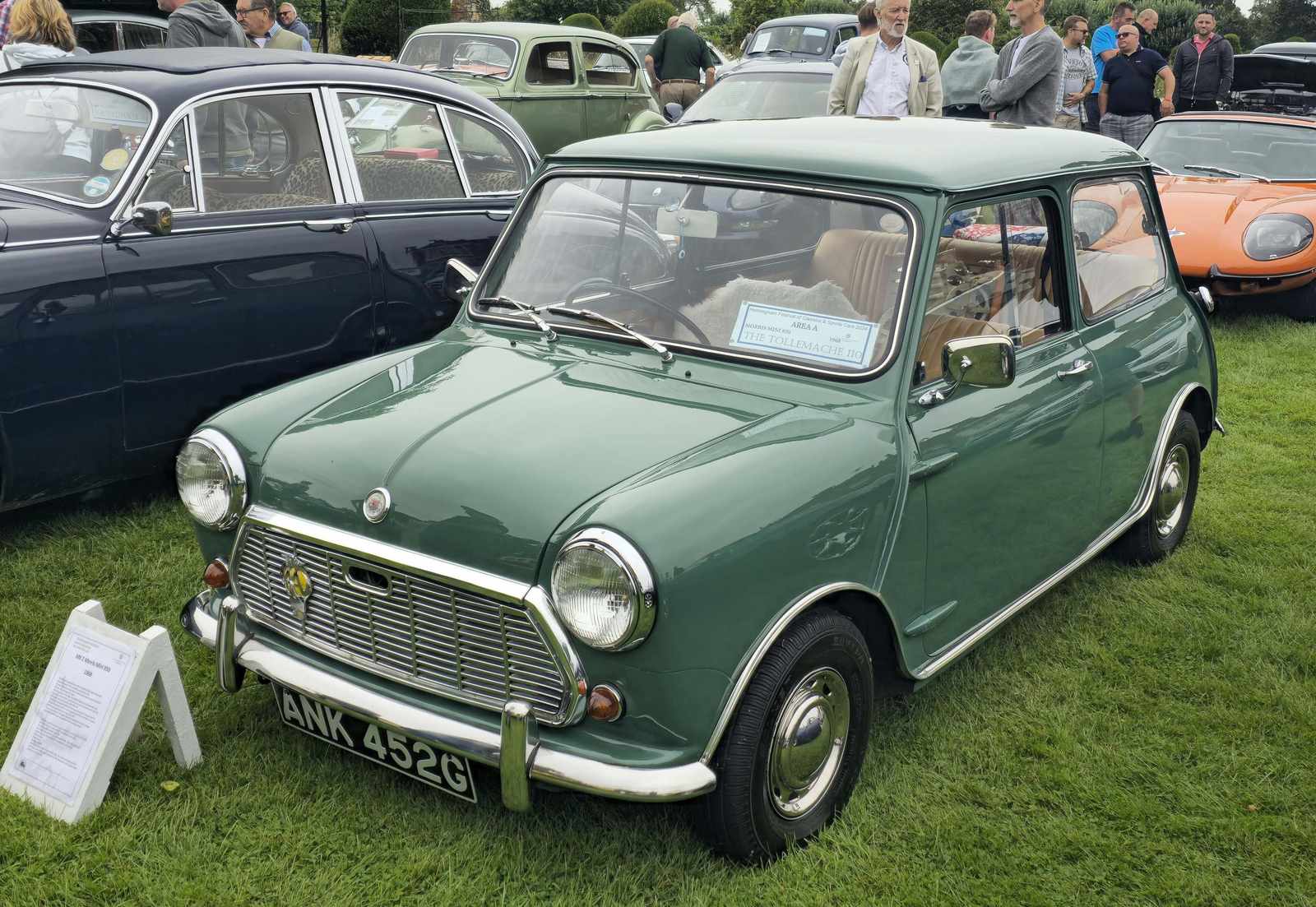
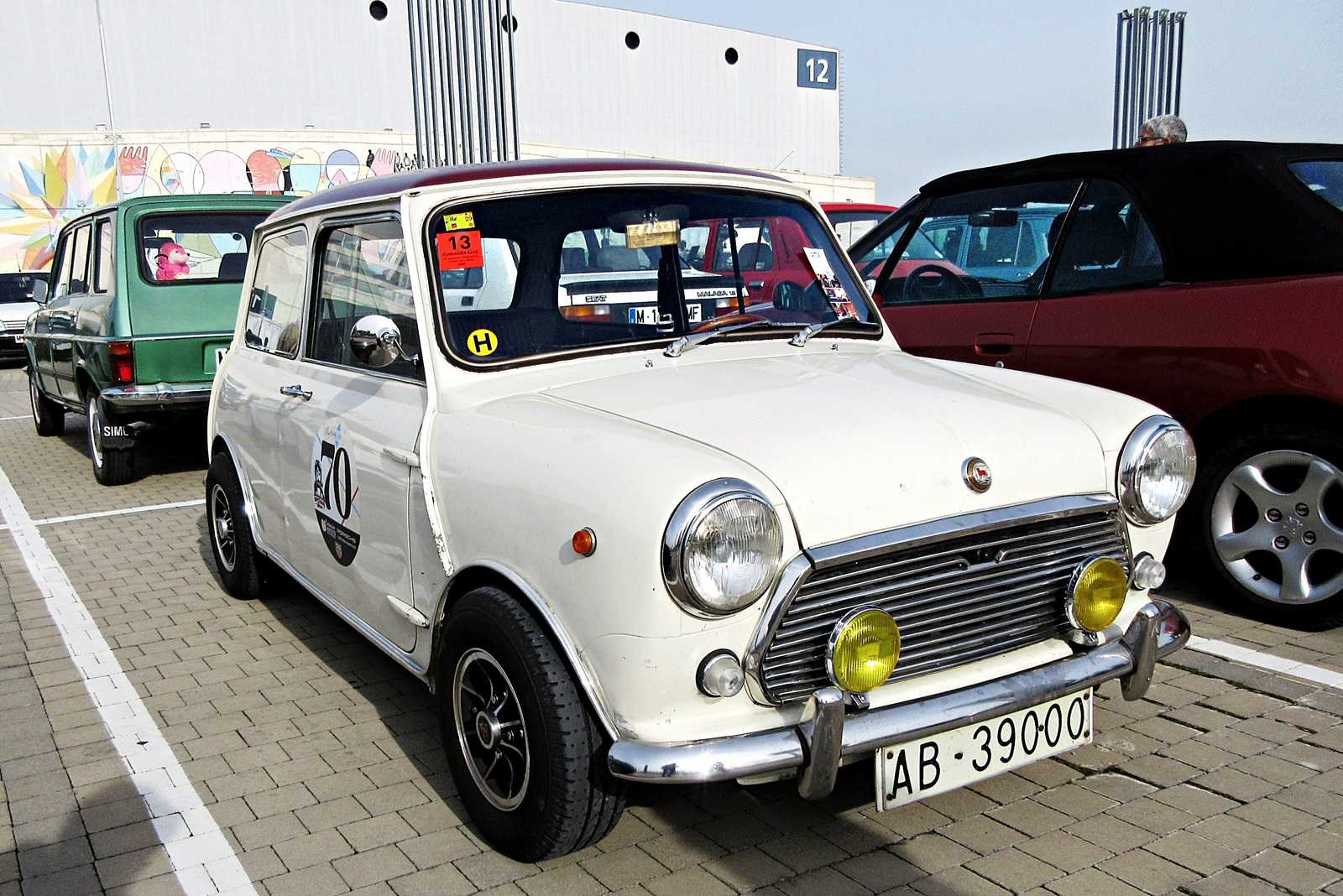
Emotionally, the Mini’s face does the work. Two round lamps, a wide grin of a grille and no aggression anywhere in the shape. It reads as friendly before it reads as fast, which is rare in a machine built to a cost. That friendliness is what let it cross class boundaries: the same car suited a student, a duchess and a bank robber on a film set.
Socially, the Mini arrived at the moment when Britain stopped dressing like its parents. It became part of the imagery of the 1960s, helped by the Monte Carlo wins of 1964, 1965 and 1967 and by The Italian Job in 1969, where three Minis outran the establishment through Turin. The car did not need advertising to become a symbol; it needed a culture that wanted a small, cheerful, cheap object to represent it.
That social meaning has outlived the engineering. A 1959 Mini is worth more today than it cost new, not because it is a better car than a modern one, but because it carries a specific idea about how ordinary life could look.
The social reading has a cost the advertising never mentions. Because the car became a symbol of informality, it also became a symbol of not having money, and by the 1980s that had flipped from charming to faintly embarrassing. The same object can carry opposite meanings in two decades without changing at all, which is what makes social meaning a design material rather than a fixed property.
The Mini did not become an icon because it was marketed. It was marketed because it had already become one.
Sources: BMW Group press release on the 1964 Monte Carlo win · The Independent, 28 Aug 1994
The designer
Issigonis designed by argument, not by drawing.
Alec Issigonis was born in Smyrna in 1906 to a Greek father and a German mother, arrived in Britain as a teenager, and trained as an engineer rather than a stylist. He drew cars on hotel notepaper and argued about them in public. His first great success, the Morris Minor, was a packaging argument as much as a shape.
He had already worked out a transverse-engine, front-wheel-drive layout for a Morris Minor replacement before he left BMC for Alvis in 1952. When Leonard Lord brought him back, the idea was waiting. The Mini is therefore not a flash of inspiration in 1957; it is an idea he had been carrying for five years, finally given a brief that made it necessary.
His method was to fix the package first and let the body be whatever the package required. That is why the Mini has almost no decorative surface: every curve is either a pressing requirement or a consequence of the wheel positions. It is also why the car dates so slowly. There is very little styling to go out of fashion.
Issigonis was also a difficult collaborator. He resisted the performance variant, distrusted marketing, and regarded the car as an engineering solution rather than a brand. That stubbornness is why the package is coherent and also why the company never built a profitable successor: the man who could solve the geometry had little interest in the product cycle around it.
The Morris Minor, his first major car, had already shown the method: a wide track, independent front suspension and a roomy body on a small footprint. The Mini applied the same logic one size down and with the engine turned sideways, which is why the two cars look like members of the same family despite eleven years between them.
Fix the package and the shape has to follow. Style the shape first and the package becomes whatever is left.
Sources: AROnline, Mini ADO15 development story · Automotive Hall of Fame, Alec Issigonis
Materials and making
Cheap materials, precise assembly.
The Mini is a welded steel monocoque with no separate chassis, which was not unusual in 1959 but was unusually demanding at this size. A monocoque distributes loads through the whole shell, so the pressings have to be accurate and the spot welds have to be in the right places. The car is simple; making it was not.
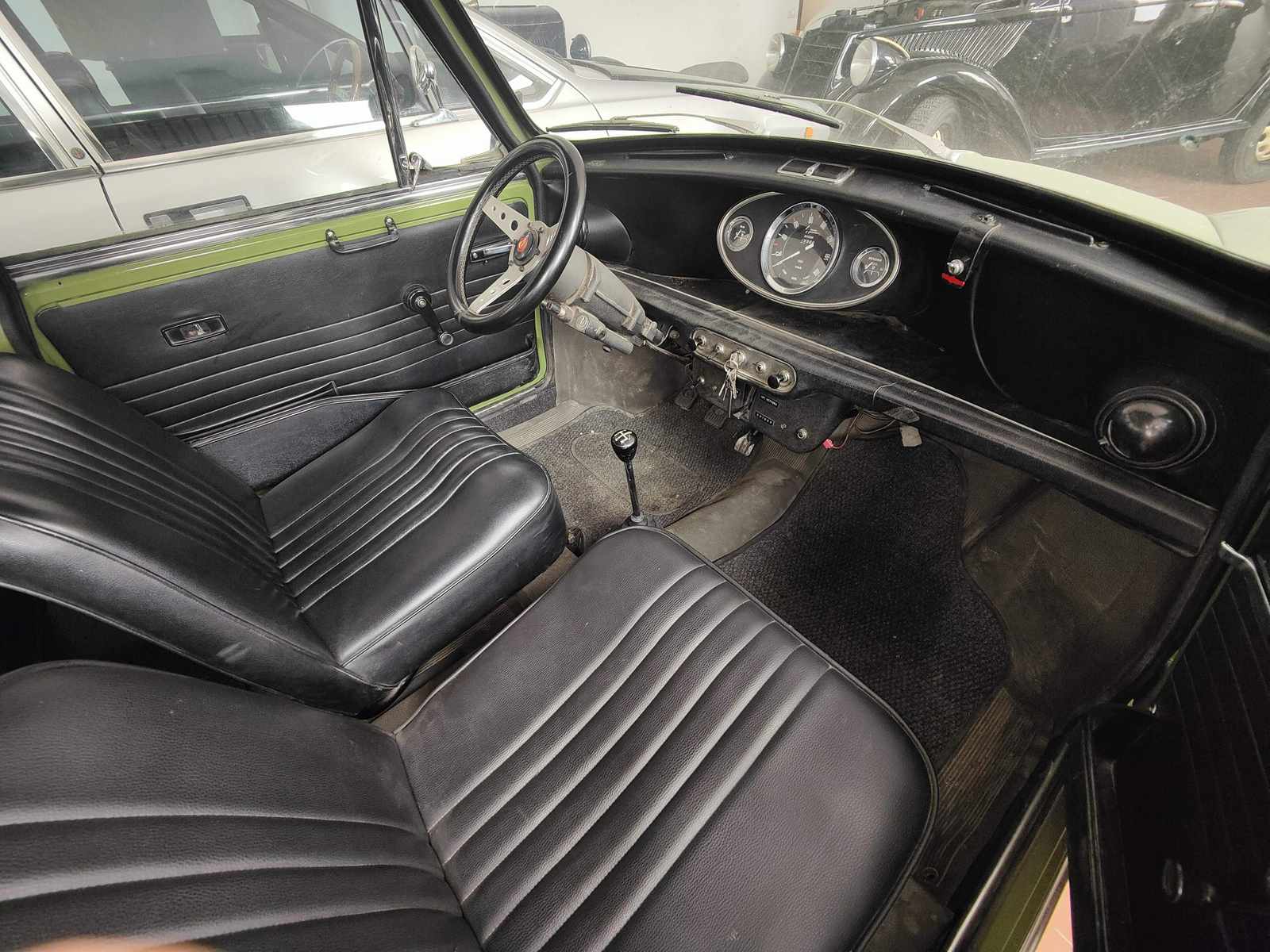
Everything a buyer could touch was specified down to a price. The windows slide rather than wind, the hinges are exposed, the door cards are board and vinyl, and the dashboard is a single central dial. Each of those decisions removed cost, weight and parts count at once, which is the only kind of saving that survives a manufacturing engineer’s review.
The engineering that is hidden is where the money went. The gearbox lives in the engine sump and shares the engine’s oil, an arrangement that saves space and weight and makes every subsequent service more difficult. The suspension uses rubber cones developed with Alex Moulton instead of steel springs, which removed the need for spring towers inside the cabin. Both are structural ideas disguised as cheap ones.
The material choices had a second life. Because the shell was simple and the panels were bolted and welded in conventional ways, the car could be repaired by a competent garage with a hammer, a welder and a parts catalogue. That repairability is why so many survive, and why the aftermarket for a car that stopped being made in 2000 is still large.
The material that did not age well is steel in a British climate. Minis rusted at the seams, the sills and the front wings, and the repair culture that grew up around the car exists partly because the body needed it. That is a design consequence too: a monocoque with hidden box sections is cheap to build and hard to protect.
Cheapness is not one decision. It is fifty decisions that all point the same way.
Sources: Wikipedia, Mini · AROnline, Mini ADO15 development story
Manufacturing
The plant could build it. The accounts could not read it.
ADO15 moved to the Austin headquarters at Longbridge, where the tooling had to press a shell with almost no flat panels and join it accurately enough for the doors to shut. The car was built on existing lines, by existing workers, alongside the much larger cars BMC was already making. That was the point: no new factory, no new engine, no new workforce.
The manufacturing decision that mattered most was the engine installation. Putting the gearbox in the sump meant the powertrain could be assembled as one unit and dropped into the car from below, which simplified the line and shrank the engine bay. It also meant the transmission shared the engine’s oil supply, a choice that would haunt owners for decades.
The system that failed was not the factory but the accounting. BMC did not have the cost-analysis systems the American manufacturers used, and according to The Independent it did not know the Mini was being built at a loss until Ford told it. Ford had bought a Mini, taken it apart, and costed every part. The answer was that BMC was losing money on each car.
Volume told the same story. BMC built more than 650,000 vehicles in the 1959-60 financial year, and the Mini became a large share of that output. A car that is cheap to make, sells in volume and still loses money per unit turns a factory’s efficiency into a financial problem rather than a solution.
A factory can be world-class at making something the finance function cannot price.
Sources: The Independent, 28 Aug 1994 · AROnline, Mini ADO15 development story
Advertising and culture
The car sold itself; the culture did the rest.
Mini advertising in the early years was modest and often dry, because the car was cheap and the margins did not allow much else. What built the reputation was evidence: the Monte Carlo Rally, where a Mini Cooper S won in 1964, 1965 and 1967, and was disqualified in 1966 on a technicality over its headlamps that the rules had previously allowed. A small car beating V8 saloons on a mountain pass is better advertising than any headline.
Then came The Italian Job in 1969, in which three Minis carry a gold heist through Turin, down steps and through a sewer. The film fixed the car in the public imagination as cheeky, quick and slightly criminal. By the 1990s the Mini was a fashion object: Paul Smith produced a limited edition in 1998 in a custom blue with citrus-green details inside the boot, bonnet and glovebox, in a run of 1,800 cars, and the car appeared in fashion photography as readily as in motoring pages.
BMW bought the Rover Group in 1994, kept the Mini name when it sold the rest in 2000, and relaunched the car in 2001 as a premium small car. The new Mini is a different engineering proposition entirely, but its entire visual identity is a quotation of the 1959 car. That is the clearest possible evidence of how much equity the original design created.
Early advertising sold economy and space, because that was the brief. The emotional territory was claimed later, by owners and film-makers rather than by the agency. When a product’s meaning is created outside the marketing department, the brand inherits it whether or not it knows what to do with it.
Rally wins gave it credibility. A film gave it personality. Neither was a marketing plan.
Sources: BMW Group press release, 50th anniversary of the 1964 Monte Carlo win · BMW Group, Mini heritage
The money
The most admired car in Britain was never its most profitable.
At £496 19s 2d the Mini was priced to sell against bubble cars, not against other proper cars. Lord’s stated ambition was to clear the roads of imports; how that price was calculated, the sources do not say. The car was engineered to be cheap to build, and Ford’s teardown later concluded that BMC was selling it below cost.
The scale is worth holding in mind. Production ran from 1959 to 2000 and reached 5,387,862 cars, according to the figure recorded when the last one left Longbridge. That is the most successful British car ever built by volume, and it was never the most profitable model in the range. The Independent, writing in 1994, put it well: the car had been declared the best ever built, but had never been the most profitable.
The financial failure is instructive rather than embarrassing. A design that is excellent at the product level can still fail at the business level if the pricing decision is made for strategic reasons the cost structure cannot support. The Mini was a strategic weapon aimed at imported bubble cars, and it worked. It was never a profit centre, and whether it lost money at all is more contested than the legend suggests.
The comparison with Ford is the sharpest part of the story. Ford costed the car part by part and concluded BMC was selling below cost, using the same teardown discipline it applied to competitors in every segment. BMC lacked the systems to run that calculation itself, which means the loss was not a pricing decision anyone could see, let alone defend.
The figures do not agree, and that is the finding. Beckett’s recollection, reported by AROnline, is that Ford calculated BMC was losing £30 on every car. A study at the time of the British Leyland merger put the Mini at £16 profit per car. Edwardes told Autocar in 1978 that it was substantially profitable, making several hundreds of pounds per unit, and Rover declared it profitable in 1988. What survives all of them is the fact that mattered: BMC did not know its own costs until a competitor costed the car for it.
Design excellence and commercial success are separate variables. The Mini is the proof.
Sources: The Independent, 28 Aug 1994 · The Guardian, 5 Oct 2000
Community
Owners turned a product into a membership.
The Mini’s owners did something the company never organised: they formed clubs, raced the car, restored it, and kept it on the road long after the manufacturer had stopped developing it. By the 1980s the car survived on affection and spare parts rather than on marketing.
That community is a design outcome, not a marketing one. A car that is cheap, simple, repairable and distinctive is a car people can own without a dealer. The same qualities that made it a poor profit centre made it an excellent object to belong to.
When BMW relaunched the brand in 2001, it inherited a community it had not built and could not buy. The new car’s success rests partly on that inherited goodwill, which is the only asset in the whole story that cost nothing to create and could not be recreated by spending.
The clubs also kept the knowledge alive. Workshop manuals, parts interchangeability between models and a generation of specialists who knew the car intimately are why a 1960s Mini can still be maintained today. None of that was designed as a service; it was a by-product of a car simple enough to understand.
A product people can repair is a product people can love.
Sources: The Independent, 28 Aug 1994 · BMW Group, Mini heritage
Collaboration
Three people, three disciplines, one package.
The Mini is usually credited to Issigonis alone. The record is more interesting: three figures shaped it, each from a different discipline. Issigonis owned the package. Alex Moulton, an engineer who had been working on rubber suspension for BMC, owned the ride and the space that suspension freed inside the car. John Cooper, a racing car constructor, owned the performance variant that turned a sensible small car into a competition machine.
None of those three could have produced the car alone. Issigonis’s package needed Moulton’s suspension to keep the wheel arches out of the cabin. The rally programme needed Issigonis’s lightweight structure to be competitive. The Cooper conversion needed the standard car’s inherent balance to be worth more power.
The collaboration worked because each person owned a system rather than a component, and the boundaries between the systems were argued out early. That is the same structure that makes any interdisciplinary product work: clear ownership, explicit interfaces, and a single person accountable for the whole.
Moulton’s contribution is the least visible and the most structural. Rubber-cone suspension removed the coil springs and the towers that would have eaten into the cabin, and it gave the car self-damping behaviour that suited its weight. Without that, the ten-foot package would have lost the space it was built to create.
Interdisciplinary work is not everyone in the room. It is one owner per system and an agreed interface.
Sources: AROnline, Mini ADO15 development story · BMW Group press release
Difficult decisions
What the team chose to leave out.
The Mini’s specification is a list of omissions. No heater as standard. No radio. Sliding windows. Exposed hinges. A single dial instead of an instrument binnacle. A gearbox that shares engine oil. Every one of those saved weight, cost or space, and every one of them made the car worse to live with.
The hardest decision was the engine. The 848 cc A-series produced 33 horsepower, which made the car slow on a motorway and dependent on momentum. Issigonis resisted the performance variant that John Cooper proposed, on the grounds that the car was designed for economy and space rather than speed. Cooper built it anyway, and the Cooper and Cooper S became the versions that made the car famous.
The other difficult decision was not to replace it. The Mini stayed in production for forty-one years with only incremental changes, because every attempt to design a successor either cost too much or threatened the packaging that made the original work. The car outlived BMC, then British Leyland, then Rover, and survived as a name under the company that bought the last of them.
The decision that looks worst in hindsight is the refusal to invest in safety. By the 1970s the Mini was being sold into a market where its lack of crash structure was a known weakness, and the company had no successor because every replacement threatened the price or the package. The car stayed in production because it still sold, not because it was still competitive.
The omissions are the design. Everything the car does not have is a decision someone defended.
Sources: Wikipedia, Mini · The Independent, 28 Aug 1994
What it teaches
Five decisions worth copying.
First: define the constraint as a number. Ten feet is a design brief a factory can argue with; ‘a small car’ is not.
Second: package before you style. The Mini’s proportions are a consequence of its interior, not the other way round.
Third: put the saving where the customer cannot see it. The sump gearbox and rubber cones are invisible and structural; the sliding windows are visible and cheap. Both were necessary, but only one of them made the package possible.
Fourth: cost the product before you price it. The Mini was priced strategically and costed by a competitor.
Fifth: let the object belong to its owners. The community that kept the Mini alive for twenty years was created by making the car repairable, not by making it exclusive.
A great product is a set of constraints somebody refused to negotiate.
Sources: Synthesis of the sources on this page
Evidence
| Tier | Claim | What the source says | Publisher · date | |
|---|---|---|---|---|
| C | Launch price | £496 19s 2d, August 1959 | The Independent · 1994-08-27 | source |
| C | Production total | 5,387,862 cars, 1959 to 2000 | The Guardian · 2000-10-05 | source |
| C | Production, to end-1993 | almost 5.3 million | The Independent · 1994-08-27 | source |
| C | Loss per car | BMC did not know it was making a loss until Ford told it | The Independent · 1994-08-27 | source |
| C | Brief and timing | conceived after the Suez crisis, July 1956; ADO15 team of three plus draftsmen | AROnline · 2024-02-01 | source |
| B | Monte Carlo | won 1964, 1965 and 1967; disqualified in 1966 | BMW Group · 2014-01-21 | source |
| C | Production and layout | 1959–2000, 5.38 million; transverse engine, sump transmission, front-wheel drive | Wikipedia · 2026-11-04 | source |
| B | Design principles | designed around space for four adults and their luggage inside the smallest possible footprint | BMW Group · 2019-08-26 | source |
| C | Dimensions | 3,054 mm long, 848 cc A-series engine | Wikipedia · 2026-11-04 | source |
| C | 1966 exclusion | Mini disqualified at Monte Carlo over headlamp regulations | BBC On This Day · 1966-01-21 | source |
| C | Profitability | £30 loss per car (Ford recollection), £16 profit (BL merger study), substantially profitable (Edwardes, 1978) | AROnline · 2024-02-01 | source |
Innovation Design publishes monthly. Every number links to its source. justintsui.com/innovation-research
About this research
This issue is compiled from publicly available sources: official statistics, company filings, industry
associations, peer-reviewed papers, app-store and marketplace data, and named press reporting, together with
published figures from subscription databases such as valuation registers and app-revenue panels. Those figures are
attributed as published and never re-estimated. Every figure carries its publisher, date, basis and link.
Principal sources for Innovation Design: The Independent; The Guardian; AROnline; BMW Group; Wikipedia; BBC On This Day.
This is an editorial digest for general information. It is not investment, legal or
purchasing advice. Corrections are published against the issue and the underlying evidence table is updated.