We’ve all seen the news. AI is moving from answering questions to doing our jobs. But how? As a designer and innovation coach, I constantly remind startups & founders that breakthroughs rarely happen in a silo; they are built upon meticulously layered foundations.
In my recent discussions around “Innovation SWAT” capabilities—building interdisciplinary teams to navigate uncertainty—nothing is more crucial right now than understanding the architecture of Agentic AI. It isn’t just “one thing.” It’s a complete ecosystem.
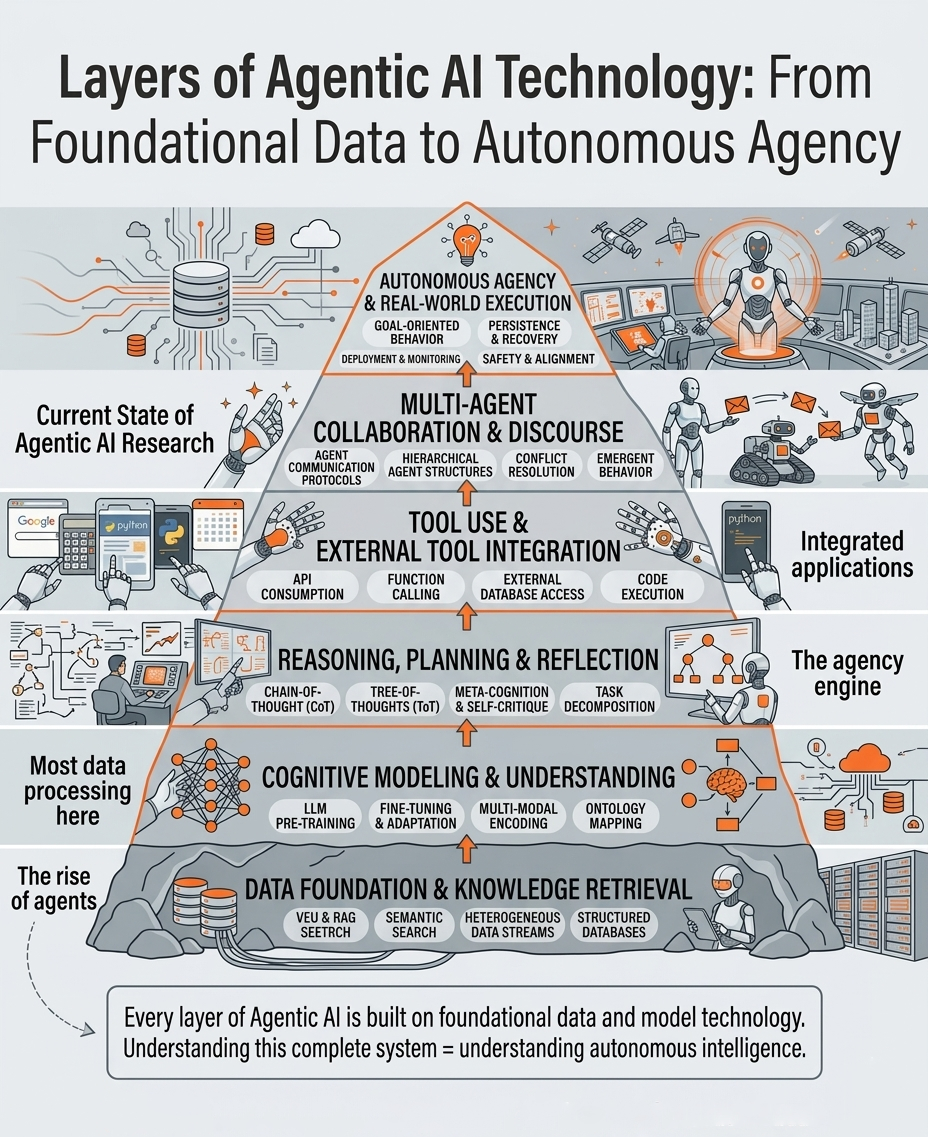
While I often use doodles to capture chaos, sometimes a structured visual is exactly what we need to simplify the complex. This fantastic infographic perfectly maps the six distinct strata required to move from data retrieval to true autonomous agency.
Let’s unpack it, from the bedrock to the breakthrough.
The Architecture of Autonomy
The journey toward autonomous systems isn’t a single step; it’s a tiered ascent. The infographic below frames this beautifully, showing that every layer is dependent on the one beneath it. If we want systems that are safe, effective, and “viable to growth,” we must master each level.
Layer 1: Data Foundation & Knowledge Retrieval
The Bedrock
Look at the bottom of the visual—the cave. I love this analogy. It’s primal, deep, and essential. You can’t have intelligence without memory.
This layer represents the raw information—the HETEROGENEOUS DATA STREAMS and STRUCTURED DATABASES that nourish the system. In innovation terms, this is our “customer-centric research and insights” core. Without verified, clean data, everything built above it is unstable.
The crucial component here is RAG SYSTEMS (Retrieval-Augmented Generation). Traditional models stop at their training date. RAG allows them to reach back into private, real-time databases—the librarian robot in the doodle—to provide answers that are sensible and credible. This matches my core coaching principle: “make judgement if the answers are credible & sensible to trust.”
Research Check: Academic reviews confirm this. As a 2025 paper in TechRxiv notes, RAG is the “conceptual foundation” that extends generative models, allowing them to retrieve data from private services “without constant prompting.”[1]
Layer 2: Cognitive Modeling & Understanding
The Translator
Once we have the data, we need a way to understand it. This layer is where LLM PRE-TRAINING and MULTI-MODAL ENCODING happen.
It’s where raw binary becomes language, images, and concepts. It’s the translation of “user research” into actionable design artifacts. I see this as the interdisciplinary bridge—taking disparate data points (text, sound, vision) and creating a unified cognitive model.
Layer 3: Reasoning, Planning & Reflection
The Agency Engine
This is the pivotal middle layer where AI moves from reactive to proactive. Notice the human in the control room doodle.
Before an agent can act, it must think. It uses techniques like CHAIN-OF-THOUGHT (CoT) and TREE-OF-THOUGHTS (ToT) to break complex problems into sequential steps. More importantly, it must engage in META-COGNITION & SELF-CRITIQUE—observing its own reasoning to identify errors or biases before they manifest. In my design thinking workshops, this is the “ideation and rapid prototyping” phase—testing ideas internally before launching them into trial.
This capability is what scholarly research identifies as the core of purposeful autonomy.[1]
Layer 4: Tool Use & External Tool Integration
The Interface
Now, the AI has a plan, but it needs hands. This layer represents the system’s ability to interact with the digital world through API CONSUMPTION and CODE EXECUTION.
This is the AI Solopreneur’s (aka One Person Company OPC’s) toolbelt. It isn’t just generating text; it’s using Python to analyze a spreadsheet, Google to verify a fact, or a calendar API to schedule a meeting. This is “addressing silo innovation” by connecting the intelligence to operational systems.
Layer 5: Multi-Agent Collaboration & Discourse
The Innovation SWAT Team
This is where the magic really happens—and where I spend my coaching time. You rarely see complex real-world projects handled by one person. You need a team: a product manager, a designer, a marketer.
AI Agents are the same. This layer maps the rise of AGENT COMMUNICATION PROTOCOLS and MULTI-AGENT ORCHESTRATION.[2] In iSWAT language, you might have one “Strategist Agent” feeding data to a “Wizard Agent,” which then delegates to a “Activator Agent,” all overseen by a “Technologist Agent.” The goal isn’t maximum autonomy; it’s the “right level of autonomy for each step.”[2]
Layer 6: Autonomous Agency & Real-World Execution
The Breakthrough
Finally, we arrive at the peak: INTELLIGENT ROBOTIC AGENTS. The glowing humanoid figure in the visual control hub.
This is the zero-to-one moment. When all previous layers work together flawlessly, the agent achieves GOAL-ORIENTED BEHAVIOR and PERSISTENCE. It isn’t just a chatbot waiting for a prompt; it’s a tireless, interdisciplinary partner that understands the objective, plans the path, assembles the team, uses the tools, and continuously optimizes for safety and alignment.
Integrated Innovation: The Takeaway
I love how the infographic’s footer summarizes it: Understanding this complete system = understanding autonomous intelligence.
For innovators and business design experts, the lesson is clear: don’t get distracted by the “peak” robot. We must invest heavily in the foundational data, the reasoning modules, and, most crucially, the collaborative multi-agent workflows.
To address the silo innovation practices in organizations, we must build systems that are feasible, desirable, and viable for growth. Mastering these six layers is how we push innovation boundaries and successfully lead complex projects from ideation to production.
What part of this layered ascent are you currently focusing on? Are you digging in the cave, or are you managing the multi-agent team? Let’s connect and continue the conversation.
[1]: Agentic AI: A Review of Architecture, Governance, and Sustainable Goal-Directed Autonomy – TechRxiv, 2025. https://www.techrxiv.org/doi/full/10.36227/techrxiv.176703982.24212722/v1
[2]: Multi-Agent Orchestration: How to Build Agent Teams That Actually Work | MindStudio blog, 2026. https://www.mindstudio.ai/blog/multi-agent-orchestration-patterns
*This article is written with AI Assistant.