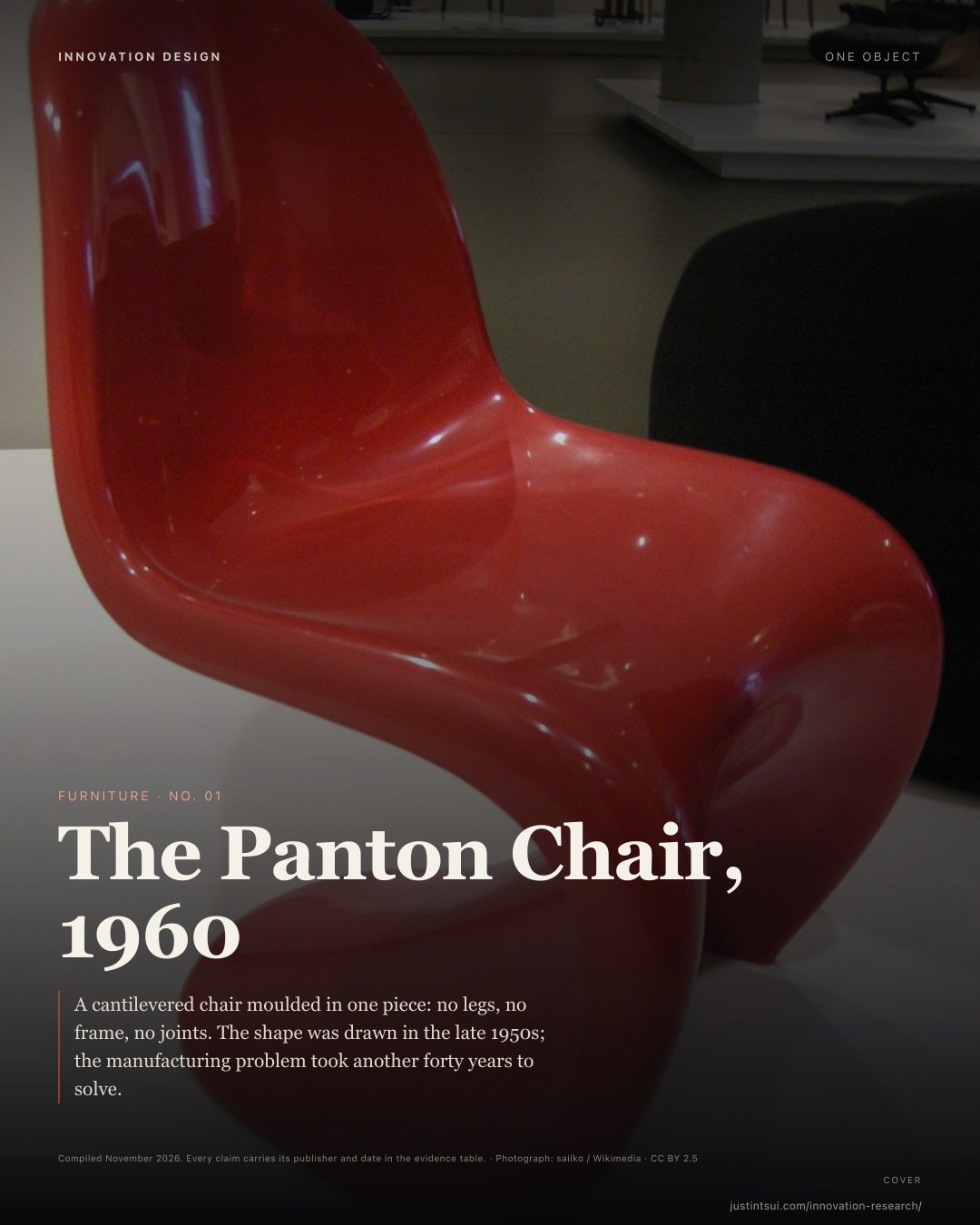
A cantilevered chair moulded in one piece: no legs, no frame, no joints. The shape was drawn in the late 1950s; the manufacturing problem took another forty years to solve.
The brief
A manufacturing problem disguised as a drawing.
In 1956 Verner Panton entered a competition run by the German furniture firm WK-Möbel with a chair made from a single section of material. The entries lost. The idea did not: sketches from about 1957 describe the chair that went into production a decade later, and in 1960 the Danish workshop Dansk Akrylteknik made a full-scale model in extruded polystyrene that could not be sat on.
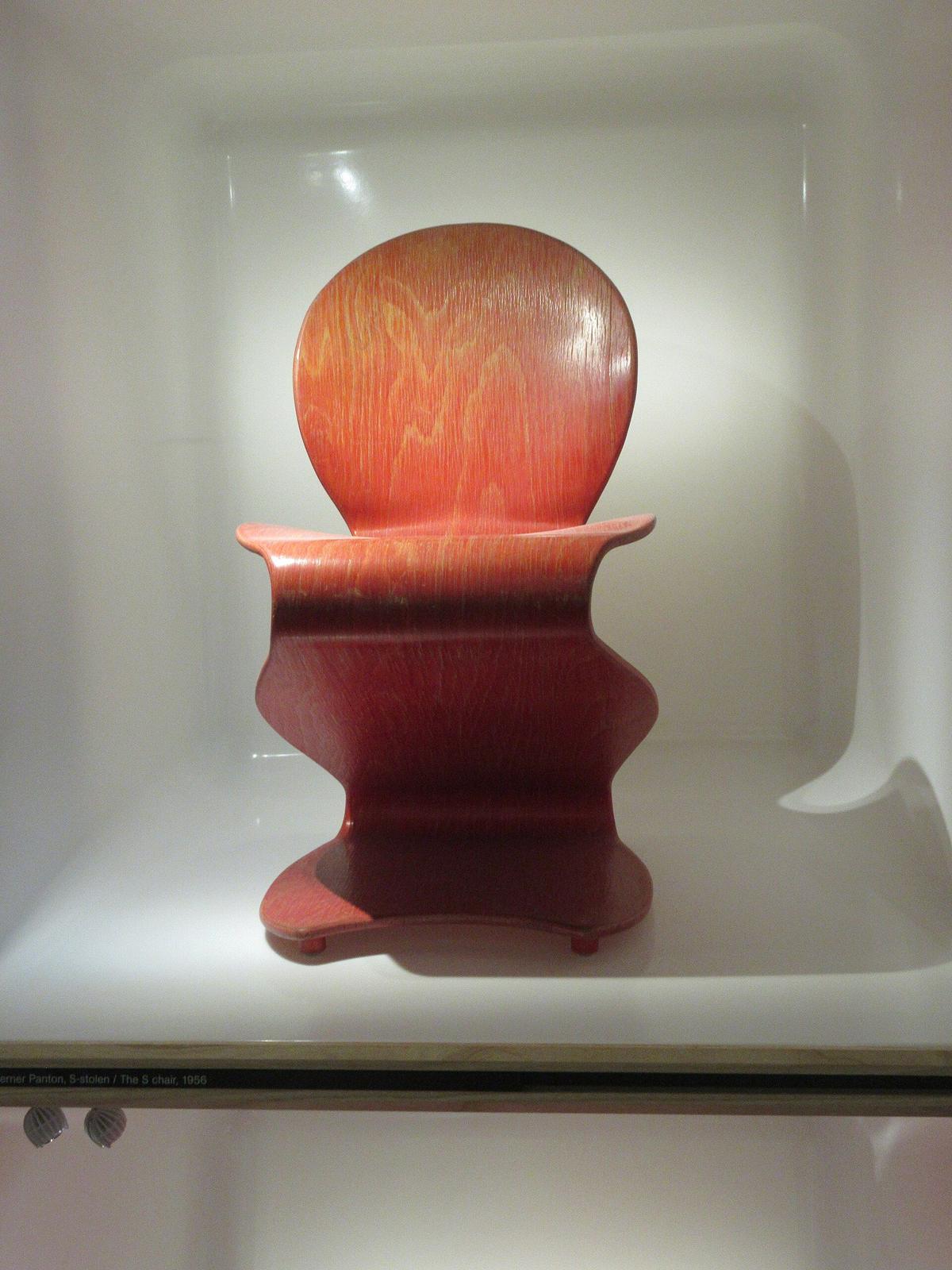
Panton had proved the curve in wood. The S-chair of 1956, produced by Sommer and marketed by Thonet as models 275 and 276 from 1965, was the first cantilevered chair made from a single piece. It could only be made in small numbers, because pressing plywood is slow. The plastic version kept the curve and changed the economics.
The anecdote the museums repeat is that a stack of plastic buckets gave Panton the idea of a stackable shell. The requirement was real: a chair that nested, shipped flat and came out of one cycle, from a material that needed no joinery.
By 1963 Panton had a model and no factory. Willi Fehlbaum, Vitra’s managing director, agreed to develop it. Ten hand-laminated prototypes followed between 1965 and 1967. What governed the project was not a dimension but a finishing time: thirty minutes of handwork per chair, which made the first version impossible to sell at the promised price.
The brief was a process that did not yet exist.
Sources: Verner Panton Design AG, Panton Chair · V&A, object O120564 · Vitra, Panton Chair history · Museum of Design in Plastics, 2021 · ICON, March 2010
FEES · functional
One moulding removes every joint, and every adjustment with them.
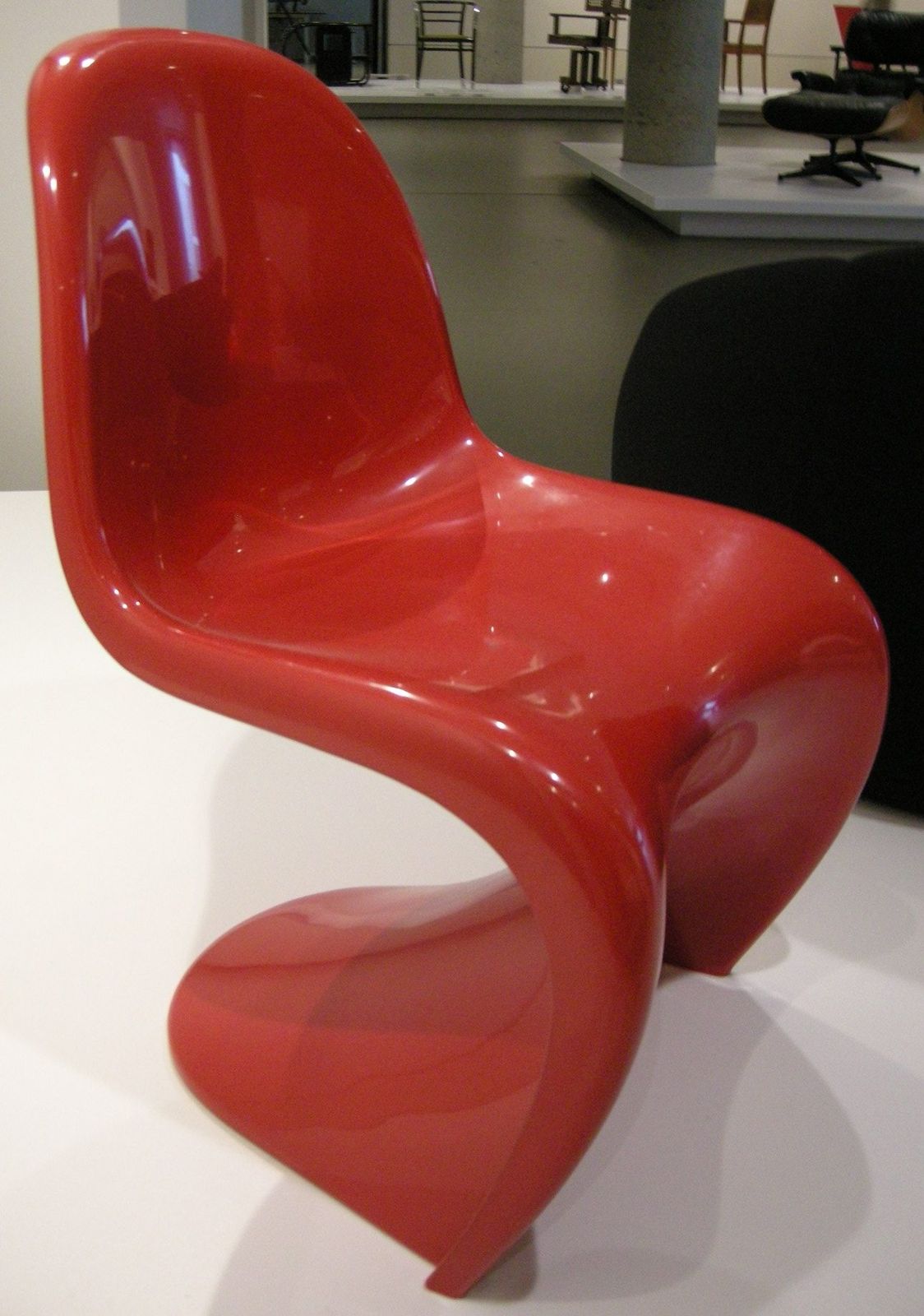
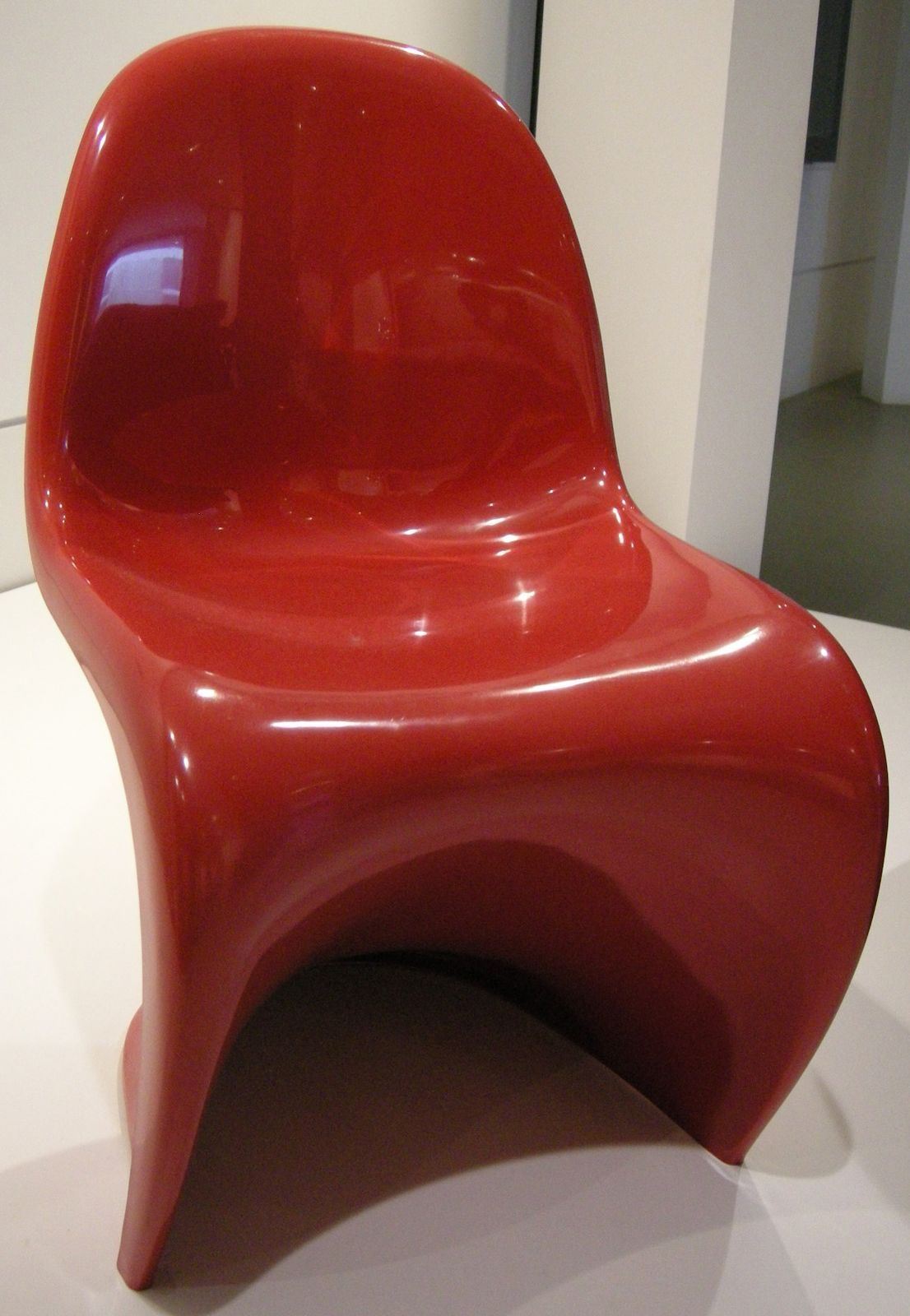
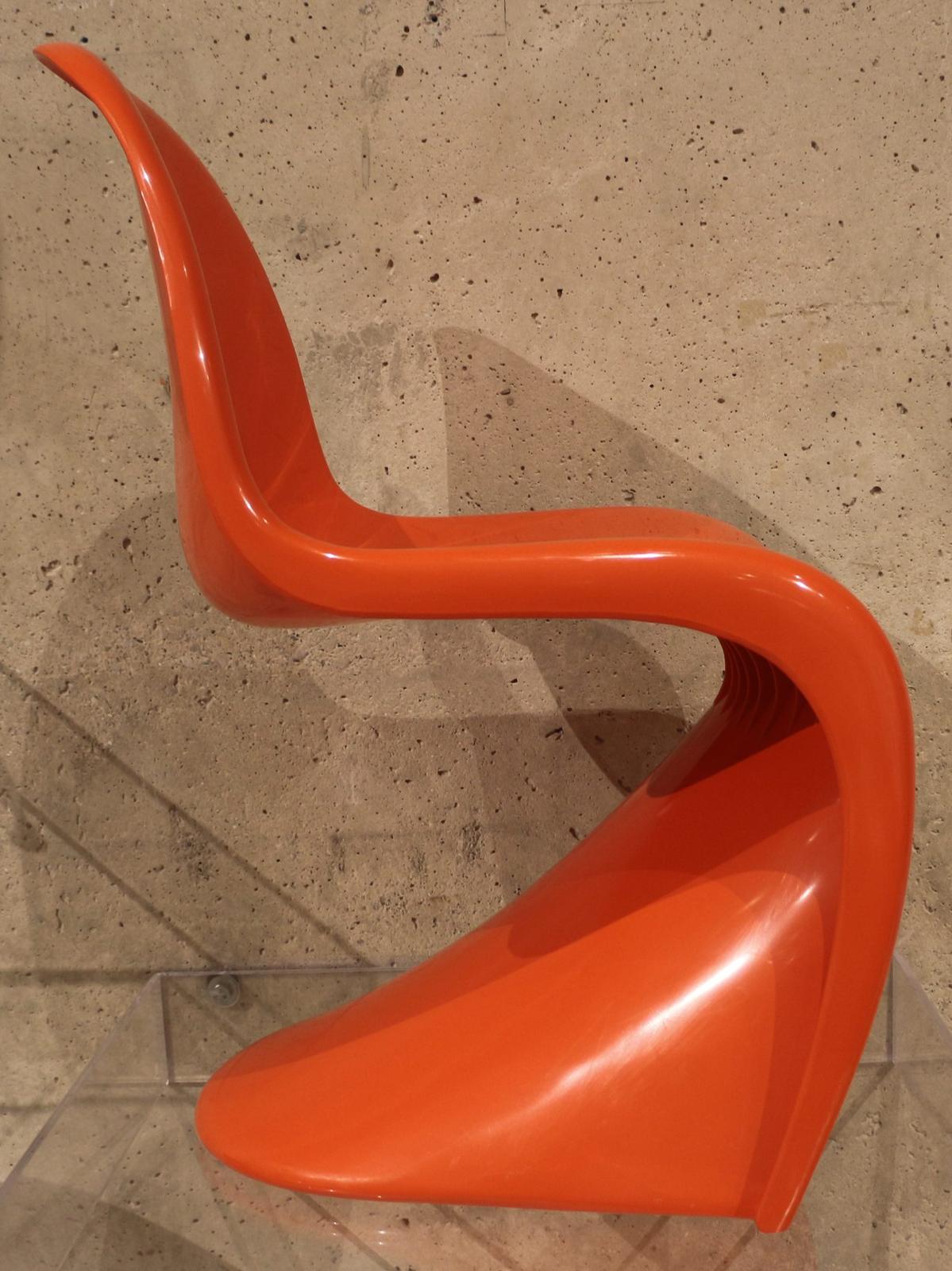
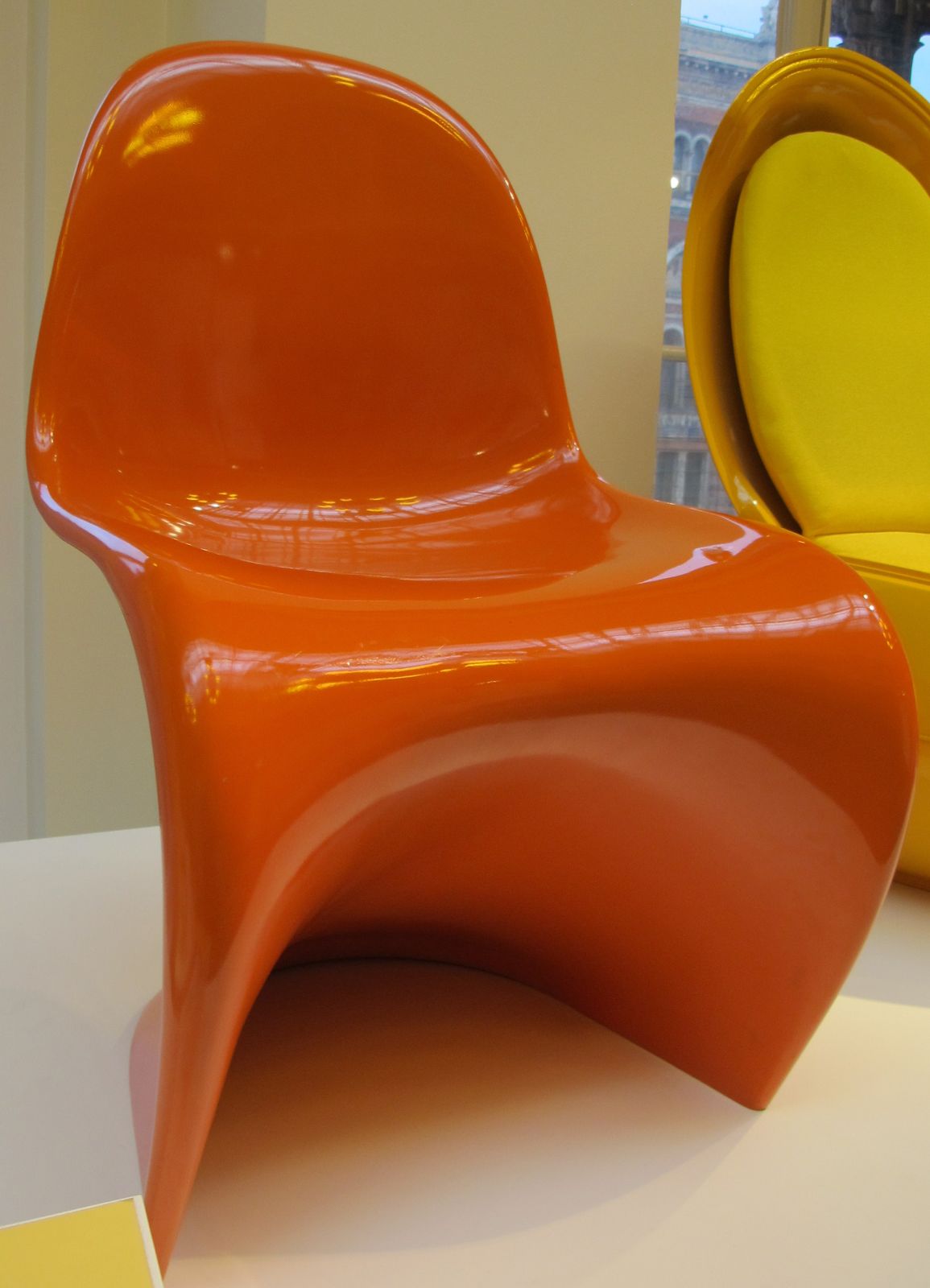
Functionally the chair is a shell. Seat, back and base are one moulding: no joints to work loose, no legs to stub a foot on, no frame to refinish. The cantilever works because the material flexes; the shell bends under load and returns, so the chair needs no cushion to feel sprung. The V&A catalogues it as a stacking chair, and that is function, not afterthought: the same curve lets chairs nest for storage and transport.
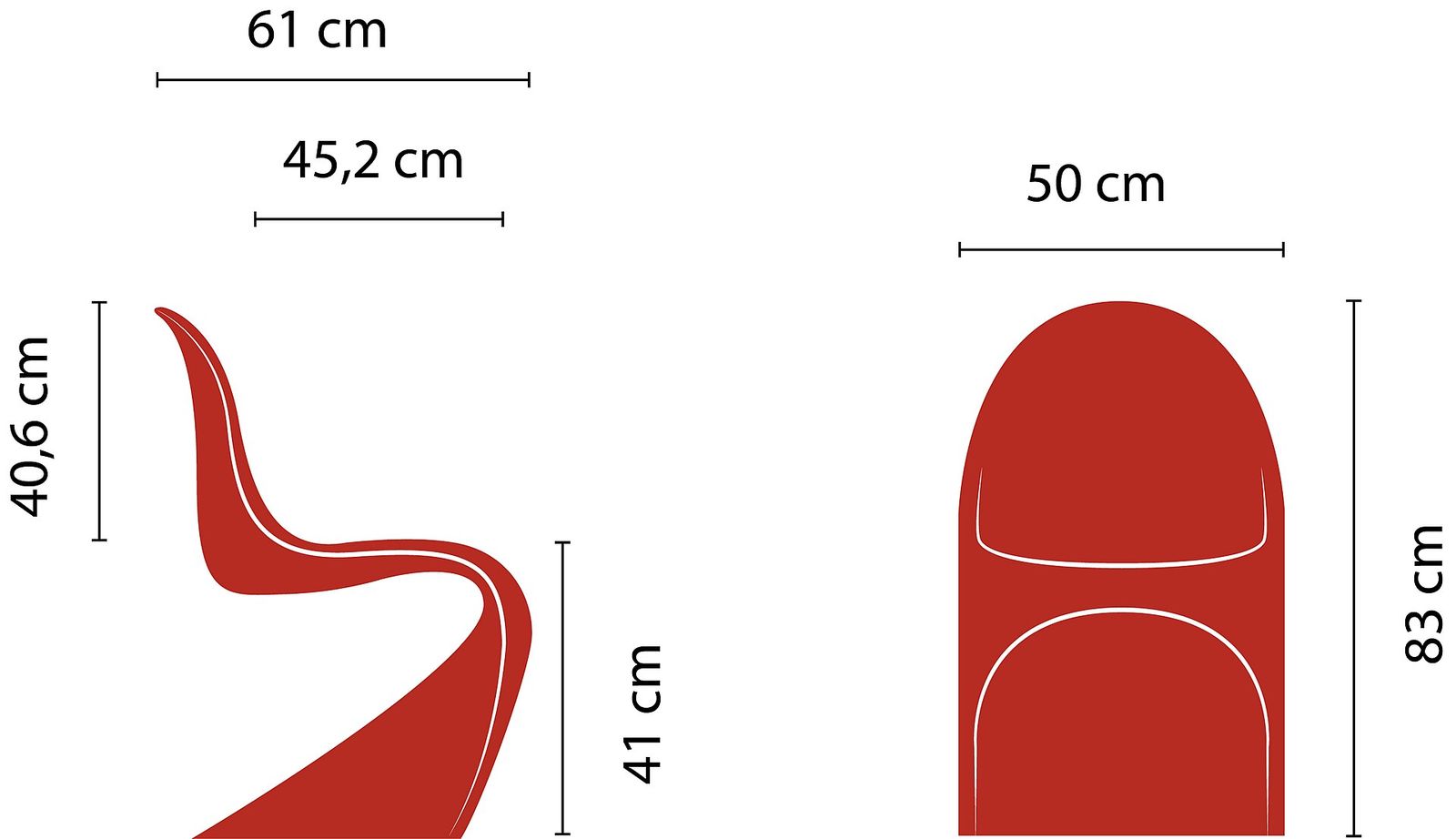
The records disagree on size. MoMA gives 81.3 by 48.9 by 60.3 cm; the V&A 82.4 by 49 by 53 cm; LACMA 83.2 by 44.5 by 48.3 cm. All three list height first, so the difference is not convention. They disagree about the depth of the object they hold, and the issue prints all three rather than choosing.
A one-piece chair has no serviceable parts. No joint to tighten, no upholstery to replace, no leg to shorten. The quality of the moulding is the whole of the product’s life: fewer ways to fail, and no way to repair.
The spring is the plastic, not the padding.
Sources: MoMA, object 498.2004 · LACMA, object 470 · Vitra, product information · V&A, object O120564 · Museum of Design in Plastics, 2021
FEES · experiential
A hard surface that behaves like a sprung one.
Sitting in it is a negotiation with a surface. There is no upholstery and no give beyond the shell, so the chair holds the body in one position and asks it to stay there. The curve does what padding does: it spreads load along the back and thighs instead of concentrating it. No arms means no leaning on an elbow; the chair is for eating, writing or talking, not for sinking into.
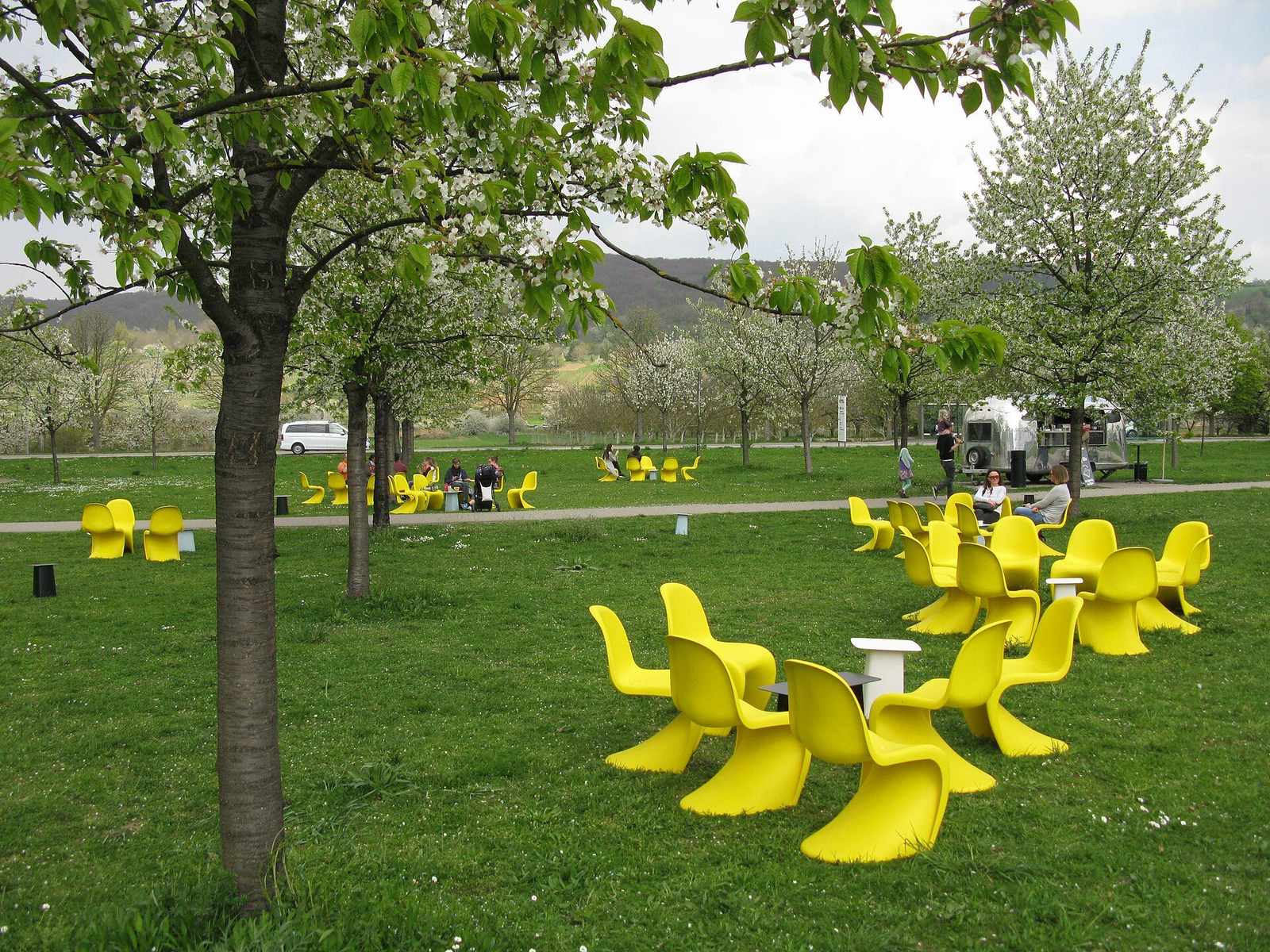
The object reads from a distance. The silhouette is legible across a room, and the cantilever makes a small promise of instability that the structure keeps. A sitter can see where to put their weight without being told. The shadow under the seat is part of the effect: the chair appears to float on a single curved foot.
The experience changed with the material, and not cosmetically. Glass-fibre was heavy and glossy, and showed every scuff. Polyurethane was glossier still. Polypropylene is matt, slightly flexible and light, and feels like a different object in the hand.
The chair explains itself before anyone sits down.
Sources: Vitra, Panton Chair history · V&A, object O120564 · Museum of Design in Plastics, 2021 · LACMA, object 470
FEES · emotional and social
It signalled the future at a price that excluded most people.
The chair arrived in colour when colour was an argument. Panton held that colour has a function rather than a decorative role. The chair was sold in strong hues that made it a sign before it was a seat, and the gloss of the early versions made colour behave like lacquer rather than pigment.
Socially it did something unusual for plastic: it signalled expense. A moulded chair was supposed to be the cheap option. This one was not, because the moulding was difficult and the finishing was by hand. Owning one in 1968 said the household had bought the future rather than the bargain.
That meaning survived the price falling. When polypropylene made the chair affordable in 1999 it kept the association with the 1960s and with design culture, which is why it appears in fashion photography and museum displays rather than in canteens. Denmark made the status official in 2006, when the chair entered the national culture canon.
Plastic was supposed to be cheap. This chair made it desirable instead.
Sources: Verner Panton Design AG, Panton Chair · Museum of Design in Plastics, 2021 · Vitra, product information · Wikipedia, Panton Chair
The designer
He drew shapes the industry could not yet mould.
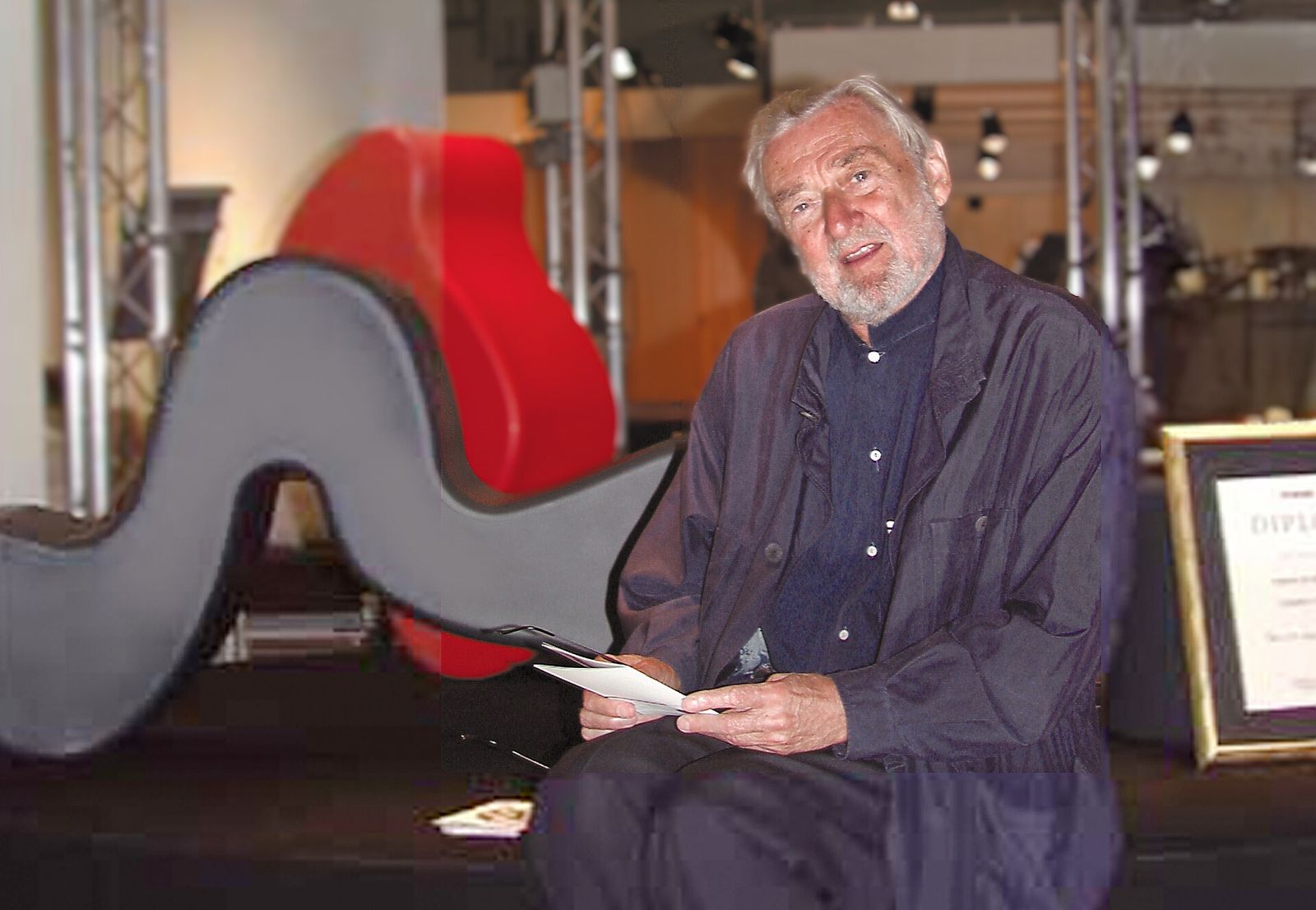
Verner Panton was born in Denmark in 1926, trained as an architect at the Royal Danish Academy, worked for Arne Jacobsen and opened his own studio in 1955. By the end of the decade he was designing rooms rather than objects: the Varna restaurant in Aarhus, then the Visiona installations for Bayer in 1968 and 1970.
His method was to treat a room as one composition of colour, light and form, which is why the chair looks like a fragment of an interior. His weakness was the factory. He drew shapes the plastics industry of 1960 could not mould at a price anyone would pay; others closed the gap over three decades.
He said the purpose of his work was to provoke people into using their imagination. He died in 1998, a year before the polypropylene version went on sale, so the affordable chair he had argued for since the 1950s arrived after him.
The shape was his. The factory was someone else’s.
Sources: Verner Panton Design AG, biography · Dezeen, 31 October 2024 · Vitra, designer biography · Vitra, interview with Marianne Panton
Materials and making
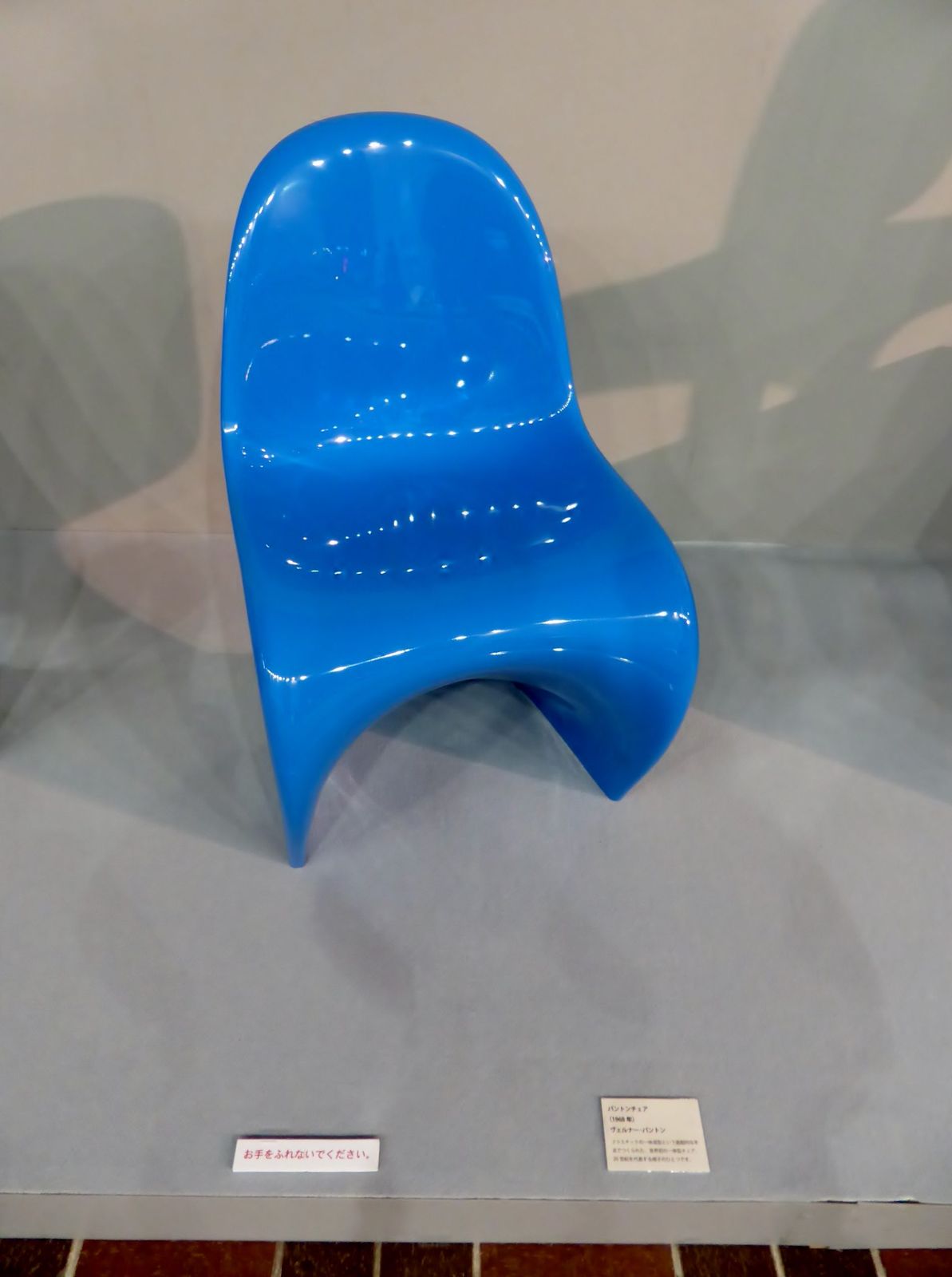
Four materials, four objects, one silhouette.
The 1967 pilot was cold-pressed glass-fibre reinforced polyester, hand laminated at first and then pressed, painted and finished. It was stiff, heavy and slow: the V&A records thirty minutes of work per piece. The 1968 version was rigid polyurethane foam, supplied by Bayer as Baydur, cast in a mould and painted. It allowed larger quantities but still needed manual finishing, which kept the price high.
The 1971 version was BASF’s Luran S, a thermoplastic that could be injection moulded from pre-dyed granules, so the chair came out of the tool coloured and did not need painting. The ridges under the seat are the mark of that change: the process could not vary wall thickness, so the design was thickened where it needed strength.
That material aged badly. Chairs broke under dynamic load and production stopped in 1979. When it resumed in 1983 under the German firm Horn, and again at Vitra in 1990, the chair went back to polyurethane foam: more expensive and slower, but resistant to breakage. That is the version still sold as the Panton Chair Classic, signed on the base.
The 1999 version used polypropylene, injected, matt and fully recyclable. It is the first to meet the cost target Panton set in the 1950s. Each material bought a lower price with a shorter expected life, and the current chair is the cheapest and least permanent of the four.
Every material change was a price cut paid for in durability.
Sources: Verner Panton Design AG, Panton Chair · V&A, object O120564 · Vitra, Panton Chair history · Museum of Design in Plastics, 2021 · Vitra, product information
Manufacturing
The factory decided when the chair could be sold.
The chair was made in two places. Vitra produced it in Weil am Rhein; Herman Miller, which held the American licence, produced it in Zeeland, Michigan. The V&A’s example, made in 1968, was bought directly from Herman Miller UK. The tooling, not the drawing, set the schedule, and the two plants did not necessarily change material on the same date, which is one reason surviving chairs are hard to date from the outside.
The first series was 150 chairs, cold-pressed and hand finished, and Vitra’s own account says the process could not keep up with demand. The polyurethane version of 1968 answered with a moulding technique that produced more units. The polystyrene version of 1971 removed the finishing stage, and that is where the cost fell. Injection moulding also removed the need to paint, a cost that does not appear in the catalogue but dominates the factory.
Then the material failed in service. Chairs broke, production stopped in 1979, and Vitra describes taking years to recover. The gap lasted until 1983, when Horn resumed production; Vitra took the chair back in 1990. A chair that costs less to make but breaks in use transfers cost from the factory to the customer and then back to the brand.
The current chair is a single injection moulding in seven colourways, with no finishing stage and no assembly. The factory Panton needed in 1959 finally exists, and it took a different material and a different tool to build it.
A production stop is a design decision that arrives late.
Sources: Vitra, Panton Chair history · V&A, object O120564 · Verner Panton Design AG, Panton Chair · Vitra, product information
Advertising and culture
It became a prop before it became a classic.
The chair was published before it was widely sold. The Danish magazine Mobilia presented it in 1967, and the image did work a specification sheet could not: a chair with no legs, in colour, in a room. Mobilia was where Danish design argued with itself in public, so the chair arrived with a critical audience rather than a retail one.
In May 1971 the photographer Brian Duffy shot Amanda Lear with the chair for Nova, in a sequence titled How to undress in front of your husband. The Duffy Archive dates the issue to May 1971; ICON dates the shoot to 1970. The archive’s date is preferred here, and the discrepancy is printed rather than smoothed.
It kept working as a prop: British Vogue, January 1995, with Kate Moss, photographed by Nick Knight. The pattern is consistent. The chair is used where an image needs a shape that is modern without being new. Vitra now sells it with the line The Original is by Vitra — advertising aimed at copies rather than customers.
A chair can be marketed by photographs it did not commission.
Sources: Duffy Archive, Nova May 1971 · ICON, March 2010 · Museum of Design in Plastics, 2021 · Dezeen, 31 October 2024 · Vitra, The Original is by Vitra
The money
The design was finished in 1967. The business case took until 1999.
No primary source located for this issue gives the 1967 retail price. The pilot series was small and the surviving records are production and museum records rather than price lists, so the launch price is recorded as not found rather than estimated. The argument that the chair was expensive at launch therefore rests on its method of manufacture, not on a price list that can be checked.
What can be checked is the price now. In Germany in November 2026 the polypropylene version sold for 365 euros at two independent retailers, and the polyurethane Panton Chair Classic for 1,619 euros at one of them, both including VAT. The Classic costs about 4.4 times the standard chair for the same silhouette, because it is cast and hand finished rather than injected. The children’s version sold for 229 euros.
That spread is the business story. The chair was designed to be cheap, and it took thirty-two years, from series production in 1967 to the polypropylene version in 1999, to become so. Vitra is family owned and does not publish the product’s margin, so the profit on a 365 euro chair is not found. The gap between the two versions is the closest public evidence of what the finishing costs.
The risk in that promise is visible in the record. The version that finally met the price target was also the version that changed the material, the surface and the expected life. Affordability was not a discount applied to the original chair. It was a different chair with the same outline.
Affordability was the hardest part of the design.
Sources: smow, prices retrieved 5 November 2026 · Connox, price retrieved 5 November 2026 · Verner Panton Design AG, Panton Chair · Vitra, Panton Chair history
Community
A chair copied everywhere is a chair with a public it never organised.
The chair never had a club. Its community formed around ownership and around copying: first-series glass-fibre chairs are collected, the polypropylene chair is sold in seven colours and imitated widely, and the silhouette is one of the most reproduced in furniture. Museums supplied the permanence a club would have supplied: MoMA, the V&A, LACMA, the Danish Museum of Art and Design and the German Historical Museum, among others.
In 2010 Vitra ran a competition asking architects and designers to customise the chair; 31 entries were auctioned for Shelter. The Panton Junior, a scaled version for children, has been in the range since 2007 according to Vitra and since 2005 according to the designer’s estate, another date printed both ways. The Junior is the clearest sign that the chair has become a domestic object: it is sold to be climbed on.
Repair is the weak point. A one-piece plastic chair has no joints to tighten and no upholstery to replace, so it either survives or it does not. The polypropylene version is recyclable, a different afterlife from the one the glass-fibre chairs have found in auction rooms, and the two do not overlap: the chairs that are collected are the ones that were hardest to make.
The community is divided by material. Collectors want the version that failed commercially. Users buy the version that succeeded.
A chair with no parts can be repaired only by replacing it.
Sources: Vitra, product information · Vitra, Panton Chair history · Verner Panton Design AG, Panton Chair · Museum of Design in Plastics, 2021 · Wikipedia, Panton Chair
Collaboration
One owner per system, and the mould has the final vote.
The collaboration had four parties and a clear division. Panton owned the form. Vitra owned the tooling and the process: Willi Fehlbaum agreed to try, and his son Rolf, with head of product development Manfred Diebold, pushed the project after seeing a prototype in Panton’s studio. Bayer owned the polyurethane. BASF owned the polystyrene. Dansk Akrylteknik made the first full-scale model, and Herman Miller handled the American market.
Panton’s own account is that fifteen to twenty manufacturers rejected the chair before Rolf Fehlbaum saw it, and that without him there would have been no Panton Chair. The quote is a designer’s memory rather than a record, but it names the interface that mattered: the person who could commit a factory. A design of this kind cannot be sponsored by a drawing.
The interface broke when the material changed. Injection moulding could not vary wall thickness, so the design grew ridges and the seat changed shape. The drawing lost authority to the tool, routine in plastics and unusual in furniture, where the designer usually controls the profile to the millimetre.
The move to Basel is part of the same story. Panton left Denmark in the early 1960s, and Vitra’s account records that the move was closely linked to the chair’s development. The object was made possible by a designer willing to live next to the factory.
The person who can commit a factory is part of the design team.
Sources: Vitra, Panton Chair history · Verner Panton Design AG, Panton Chair · V&A, object O120564 · Vitra, interview with Marianne Panton
Difficult decisions
Removing the legs, then defending the result.
The first decision was to ship a chair that a respected designer said was not a chair. George Nelson, Herman Miller’s design director, called it a sculpture rather than a chair, and ICON records that his objection was also about bulk: compared with the Eames shell chairs, which used a metal base, the Panton chair carried its whole structure in the shell.
The second was to change the material three times in twelve years. Each change kept the silhouette and altered the object: weight, gloss, ridges, expected life. The third was to stop. In 1979 Vitra ended production because the polystyrene chairs were breaking, and describes the years that followed as a recovery from a quality defect rather than a pause. Ending a successful product is the decision most manufacturers avoid.
The hardest claim to defend is priority. Panton was not the first Danish designer to reach the form. Gunnar Aagaard Andersen made a mock-up in 1953 and Poul Kjærholm in 1955, and Aagaard Andersen accused Panton of copying. ICON’s reading is that the material dictated the shape, so similar answers were inevitable, and that Panton’s achievement was tenacity rather than invention.
That is the strongest case against the chair, and it is printed rather than buried. What makes it a design is the sixteen years between the idea and the factory, and the thirty-two years between the factory and the price.
The most celebrated part of the story is the part that is contested.
Sources: ICON, March 2010 · Vitra, Panton Chair history · V&A, object O120564
What it teaches
Five decisions worth copying.
Five decisions worth copying, in the order the issue reaches them.
A single piece is a promise about the factory, not about the drawing.
Sources: Synthesis of the sources in this issue · Vitra, Panton Chair history · ICON, March 2010
Evidence
| Tier | Claim | What the source says | Publisher · date | |
|---|---|---|---|---|
| B | Design | a full-scale model made by Dansk Akrylteknik in 1960; sketches from about 1957 | Victoria and Albert Museum · 2026-11-05 | source |
| A | Prototypes | about ten hand-laminated glass-fibre prototypes 1965-67; met Willi Fehlbaum in 1963 | V&A · 2026-11-05 | source |
| B | Pilot | 150 chairs, cold-pressed glass-fibre polyester, 1967 | Vitra · 2026-02-13 | source |
| A | Pilot | 100 to 150 chairs in the same first series | V&A · 2026-11-05 | source |
| B | Materials | glass-fibre 1967; polyurethane 1968; polystyrene 1971; no production 1979-83; polypropylene 1999 | Verner Panton Design AG · 2026-11-05 | source |
| A | Cost | 30 minutes of finishing per chair before injection moulding | V&A · 2026-11-05 | source |
| A | Failure | breakages from 1974; production stopped in 1979; Vitra took years to recover | V&A · 2026-11-05 | source |
| A | Size | 81.3 x 48.9 x 60.3 cm, 2004 example, object 498.2004 | MoMA · 2026-11-05 | source |
| A | Size | 83.2 x 44.5 x 48.3 cm, model PA100, 1967 | LACMA · 2026-11-05 | source |
| C | Reception | Nelson called it a sculpture, not a chair; Aagaard Andersen 1953 and Kjaerholm 1955 came first | ICON · 2010-03 | source |
| C | Publication | on the cover of the Danish design magazine Mobilia, 1967 | Dezeen · 2024-10-31 | source |
| B | Nova | Amanda Lear photographed by Brian Duffy with the chair, May 1971 | Duffy Archive · 2026-11-05 | source |
| C | Vogue | British Vogue, January 1995, Kate Moss by Nick Knight | Museum of Design in Plastics · 2021-04 | source |
| C | Price | Panton Chair 365 EUR, Classic 1,619 EUR, Junior 229 EUR, incl. VAT | smow · 2026-11-05 | source |
| C | Price | Panton Chair 365 EUR incl. VAT at a second retailer | Connox · 2026-11-05 | source |
| B | Junior | in the range since 2007 per Vitra; the estate dates it from 2005 | Vitra · 2026-02-13 | source |
| B | Material | dyed-through polypropylene, 100% recyclable, seven colourways | Vitra · 2026-10-17 | source |
| B | Move to Basel | the move from Denmark to Basel was closely linked to the chair’s development | Vitra · 2026-02-13 | source |
Innovation Design publishes monthly. Every number links to its source. justintsui.com/innovation-research
About this research
This issue is compiled from publicly available sources: official statistics, company filings, industry
associations, peer-reviewed papers, app-store and marketplace data, and named press reporting, together with
published figures from subscription databases such as valuation registers and app-revenue panels. Those figures are
attributed as published and never re-estimated. Every figure carries its publisher, date, basis and link.
Principal sources for Innovation Design: Victoria and Albert Museum; V&A; Vitra; Verner Panton Design AG; MoMA; LACMA; ICON; Dezeen.
This is an editorial digest for general information. It is not investment, legal or
purchasing advice. Corrections are published against the issue and the underlying evidence table is updated.